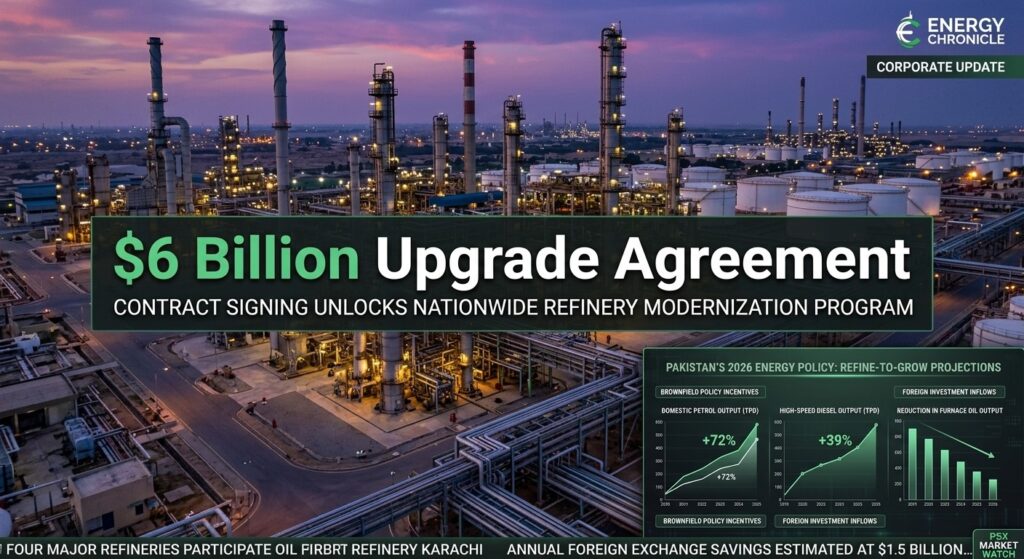
Four major Pakistani oil refineries—PRL, NRL, ARL, and Cnergyico—have formalized binding upgrade agreements totaling between $5 billion and $6 billion under the updated Brownfield Petroleum Refining Policy 2026. The initiative provides massive tax exemptions and tariff protections to modernize infrastructure over a five-year execution window.
Pakistan’s energy sector has achieved a major milestone as leading domestic oil refineries formalize multi-billion-dollar modernization contracts. Driven by the updated Brownfield Petroleum Refining Policy 2026, four out of the country’s five domestic refineries have signed legally binding upgrade agreements with the federal government. These sweeping deals represent a massive capital injection, with total investments estimated between $5 billion and $6 billion. The core objective of this initiative is to overhaul aging infrastructure, drastically reduce the nation’s reliance on imported refined petroleum, and align domestic fuel production with modern environmental standards.
What Are the Key Policy Parameters and Deadlines?
To ensure the timely execution of this modernization effort, the Ministry of Energy (Petroleum Division) mandated strict timelines and oversight parameters. The formal agreements were required to be executed ahead of a rigid October 1, 2026, signing deadline.
To enforce strict compliance, the government established severe penalties for entities that fail to meet the mandated targets. Non-compliant refineries will face direct financial penalties alongside a reduced deemed duty on high-speed diesel (HSD). Participating refineries are granted a specific five-year execution window to complete all necessary engineering and commissioning phases of their upgrades. Furthermore, Inter State Gas Systems (ISGS) has been officially designated as the central implementation entity, tasked with executing the agreements and monitoring the project rollouts.
Which Refineries Signed the Upgrade Deals?
According to official reports, four major domestic players have formally committed to the upgrade initiative under the new policy framework:
- Pakistan Refinery Limited (PRL)
- National Refinery Limited (NRL)
- Attock Refinery Limited (ARL)
- Cnergyico Pk-Limited
By executing these contracts, these operators have pledged to undertake comprehensive infrastructure upgrades that will elevate operational capacity and increase the output of higher-quality petroleum products.
What Core Incentives Does the 2026 Policy Offer?
Recognizing the immense capital required for such extensive modernizations, the Brownfield Petroleum Refining Policy 2026 provides a robust framework of financial and operational incentives. These strategic provisions are explicitly designed to ensure the commercial viability of the $5 billion to $6 billion investments.
- Tariff Protection: Upgraded refineries will benefit from a 10% deemed duty on Motor Spirit (MS) and high-speed diesel (HSD) for a continuous seven-year duration following the completion of the upgrades.
- Tax Exemptions: The policy grants a complete sales tax exemption on all imported machinery, equipment, and materials directly related to the modernization projects.
- Escrow Mechanism: To ensure transparency and strict project alignment, the financial incentives will be channeled directly into joint escrow accounts. These funds will only become accessible to the refineries upon successfully reaching predefined financial milestones.
- Operational Freedom: Once the facilities are upgraded, the operators will be granted permission to sell their refined products to any OGRA-licensed oil marketing company. Additionally, they will have the regulatory freedom to export surplus petroleum products to international markets.
The successful implementation of the Brownfield Petroleum Refining Policy 2026 marks a definitive shift toward long-term energy self-sufficiency for Pakistan. As PRL, NRL, ARL, and Cnergyico advance into their five-year engineering execution phases, the domestic petroleum supply chain is expected to become significantly more resilient, technologically advanced, and economically stable.