
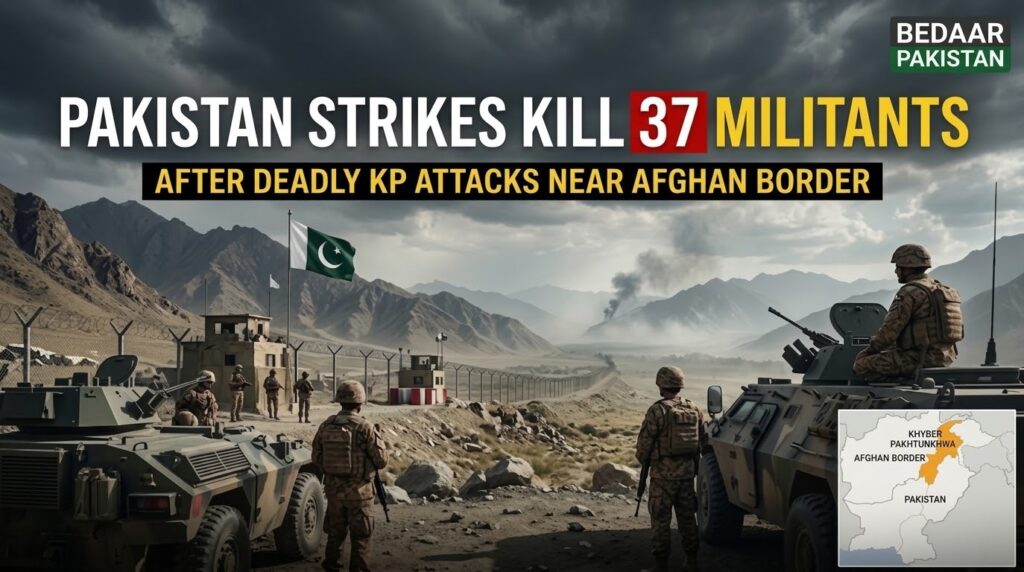
Pakistan’s security forces have killed at least 37 militants in a combined intelligence-based ground operation and calibrated airstrikes targeting hideouts in Khyber-Pakhtunkhwa and along the Pakistan-Afghanistan border. The Ministry of Information and Broadcasting confirmed the operation on Monday, describing it as a direct response to a wave of deadly attacks that had claimed the lives of civilians and security personnel across the province. The strikes mark one of the largest single counterterrorism actions this year and have added fresh strain to already tense relations between Islamabad and Kabul.
What Happened in Kohat, Hangu and Along the Border
- Security forces killed 37 militants in total, combining a ground operation and follow-up airstrikes, the Information Ministry said in a post on X.
- A “well planned intelligence based ground operation” was carried out around Kohat, Hangu and Thal on September 20, killing nine militants and wounding several others.
- Calibrated air strikes then hit three militant targets in the border region with Afghanistan, including a suicide bombers’ training markaz, killing 28 terrorists, among them multiple suicide bombers.
- Large quantities of weapons and ammunition stored at the hideouts and training centre were destroyed in the strikes.
The operation followed a suicide bombing at Kohat Police Lines on September 18, which killed at least 21 people — including 15 police personnel — and injured more than 100, during Friday prayers at a mosque inside the compound
Ground Operation and Airstrikes Follow Deadly Kohat Attack
According to the Information Ministry’s statement, the operation was launched “in the aftermath of recent multiple terrorist incidents inside Pakistan against the innocent people of Khyber Pakhtunkhwa.” Security forces first conducted the ground operation in Kohat and Hangu districts on September 20, killing nine militants during what the ministry described as a precise and effective engagement.
This was followed by what officials called selective, precision airstrikes against terrorist camps and hideouts belonging to Fitna al-Khawarij and its affiliates in the border region with Afghanistan. Three targets were destroyed, and the ministry said 28 militants — including several suicide bombers — were killed at a training facility used to prepare attackers for future bombings.
The action came days after an explosives-laden vehicle detonated near a mosque inside Kohat’s Police Lines compound on September 18, after which armed attackers stormed the site during Friday prayers. Local authorities put the death toll at 21 to 23, with 15 to 16 police personnel among the dead and more than 100 people injured. Eight attackers were killed as security forces concluded a search and clearance operation at the site. The banned Ittihadul Mujahideen Pakistan (IMP), led by Afghanistan-based commander Hafiz Gul Bahadur, claimed responsibility for the assault. A separate attack in Hangu the following day killed six security personnel, including two army officers.
Afghanistan Disputes Pakistan’s Account of the Strikes
The latest strikes have deepened tensions between Islamabad and Kabul, which have repeatedly traded accusations over cross-border militancy since the Afghan Taliban took power in 2021. Pakistan has consistently maintained that groups responsible for attacks inside its territory, including Khyber-Pakhtunkhwa and Balochistan, operate from safe havens across the border in Afghanistan.
Afghan authorities, however, disputed Pakistan’s description of the targets and the resulting casualties, saying the strikes actually hit locations in Kunar and Paktika provinces. According to Afghan officials, one house in Kunar was destroyed, killing three members of a single family and injuring four others, while a shop and an unoccupied house were damaged in Paktika. Islamabad has said its targets were confirmed militant facilities and that maximum precautions were taken to avoid civilian harm. Independent confirmation of either side’s casualty figures was not immediately available, underscoring how contested and difficult-to-verify these cross-border strikes remain.
Part of a Wider Counterterrorism Campaign
The Information Ministry noted that Pakistan’s broader counterterrorism campaign, conducted under the banners of Ghazab lil Haq and Azm-i-Istehkam, would continue. Officials reiterated that the protection of Pakistani citizens remains the government’s top priority and that the threat of terrorism facing the country continues to emanate primarily from across the Afghan border.
The latest strikes are not an isolated episode. Pakistan has witnessed a marked surge in terrorist activity in Khyber-Pakhtunkhwa and Balochistan since 2021, and security forces have carried out repeated intelligence-based operations and border strikes in response to periodic waves of attacks. The scale of this week’s action — 37 militants killed in a single 48-hour window — signals a hardening of Pakistan’s response following the Kohat mosque bombing, one of the deadliest attacks on security personnel in recent months.
What This Means for Pakistan’s Security Landscape
For residents of Khyber-Pakhtunkhwa, the operation offers a measure of reassurance after a bloody week that saw both a mosque bombing and a separate deadly clash in Hangu. But the disputed Afghan account of civilian casualties in Kunar and Paktika raises the risk of further diplomatic friction between the two neighbours, at a time when Pakistan is already pressing Kabul to act against militant sanctuaries on its soil. Analysts and regional observers will be watching closely to see whether Afghanistan’s Taliban administration responds to the strikes with its own retaliatory action, as has happened in past border flare-ups.
Pakistan’s security forces have delivered a forceful response to the deadly Kohat Police Lines bombing, killing 37 militants through a combination of ground operations and precision airstrikes across Kohat, Hangu, Thal and the Afghan border region. While Islamabad frames the action as a necessary strike against the safe havens fuelling attacks on its soil, Kabul’s disputed account of civilian casualties highlights the human cost and diplomatic risk embedded in every cross-border operation. As Pakistan’s counterterrorism campaign continues under Azm-i-Istehkam, the coming weeks will show whether this latest escalation curbs the violence in Khyber-Pakhtunkhwa or deepens the standoff with Afghanistan.