
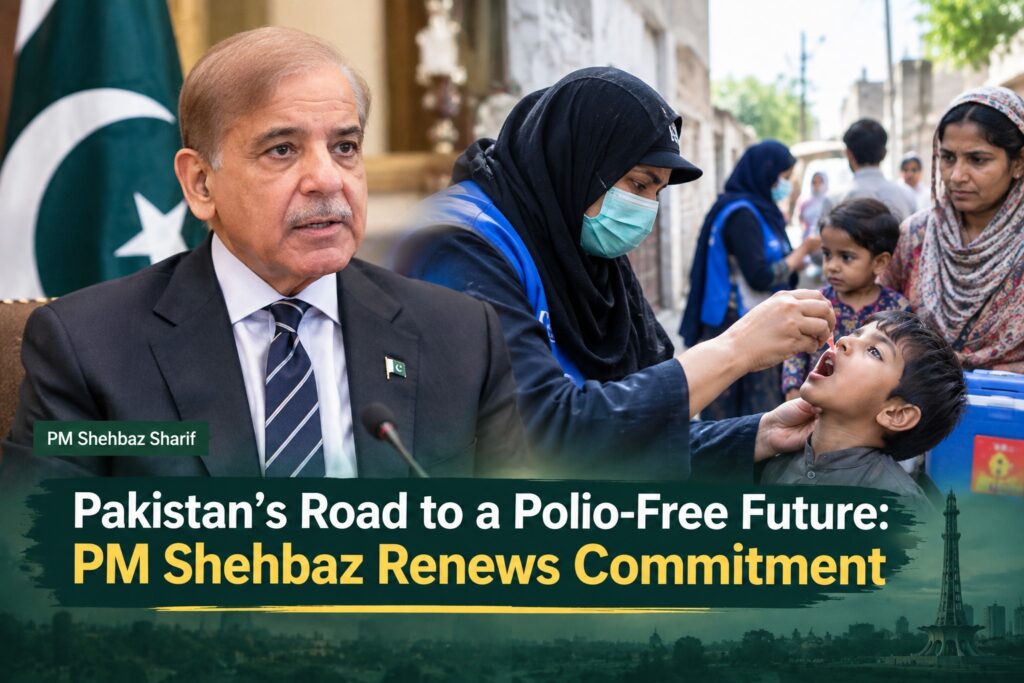
Prime Minister Shehbaz Sharif has renewed Pakistan’s commitment to completely eradicating polio, saying the country remains focused on achieving the shared goal of ending transmission of the virus. His remarks came during a meeting with a Gates Foundation delegation in Islamabad on September 10, 2026. The renewed commitment comes as Pakistan continues vaccination drives and surveillance efforts, while recent data show progress but also confirm that the poliovirus has not yet been eliminated.
PM Shehbaz Sharif Reaffirms Pakistan’s Polio-Free Future
Speaking to the Gates Foundation delegation, Prime Minister Shehbaz Sharif said Pakistan is committed to achieving the shared goal of completely eradicating polio. He also highlighted that the national polio eradication programme enjoys the highest level of government patronage.
The prime minister appreciated the Gates Foundation’s continued support and partnership in Pakistan’s development challenges. The foundation has contributed to efforts related to polio eradication, health, nutrition, financial inclusion and the welfare of vulnerable communities.
Pakistan’s latest policy message comes as the country seeks to interrupt the remaining chains of wild poliovirus transmission and move closer to becoming a polio-free country.
Pakistan Polio Cases Show Progress, But Transmission Continues
Pakistan has made substantial progress since the Pakistan Polio Eradication Programme was launched in 1994. UNICEF says the number of reported polio cases fell from around 20,000 a year in the early 1990s to eight cases in 2018.
However, Pakistan remains one of only two countries where wild poliovirus continues to circulate endemically, alongside Afghanistan. The Global Polio Eradication Initiative reported that Pakistan had recorded three wild poliovirus type 1 cases in 2026 as of September 2. The most recent reported case had onset on April 7, while six positive environmental samples were reported in August from Balochistan, Sindh and Khyber Pakhtunkhwa.
The figures underline an important point for Pakistan’s polio-free future: fewer paralytic cases do not mean the virus has disappeared. Environmental surveillance can detect poliovirus circulation even when no new human case has been reported during a particular period.
The World Health Organization’s August 2026 emergency committee statement also identified continued transmission in Pakistan, including in southern Khyber Pakhtunkhwa and Karachi. WHO’s assessment was based on an earlier reporting cut-off and therefore recorded a different 2026 case total from the later Global Polio Eradication Initiative update.
Why Polio Vaccination Pakistan Efforts Remain Critical
The Pakistan polio vaccination campaign remains central to stopping transmission. Repeated oral polio vaccine campaigns are designed to build immunity among children, particularly those who may have missed routine immunisation or live in areas where the virus is still detected.
UNICEF says the programme uses vaccination teams, community mobilisers and transit vaccination points to reach children who are moving between districts or travelling across the country. Permanent transit points operate at locations such as railway stations, bus stops and highways.
In March 2026, UNICEF said a partnership with the King Salman Humanitarian Aid and Relief Centre had helped vaccinate 2.8 million children against polio while also strengthening routine immunisation and health systems. The initiative also supported birth-dose vaccination services and efforts to reduce the number of children who had received no vaccines or were behind on immunisation.
These efforts show that Pakistan’s fight against polio is not limited to short vaccination drives. It also involves routine immunisation, surveillance, community engagement and efforts to reach children who are difficult to access.
Challenges Behind Pakistan’s Fight Against Polio
The biggest challenge is not simply delivering vaccine doses. Reaching every child consistently is essential because pockets of low immunity can allow poliovirus to survive and spread.
Population movement is another important factor. Children travelling with families, seasonal migrants and communities in hard-to-reach areas can be missed during vaccination activities. The virus can also move across borders, making coordination between Pakistan and Afghanistan important for eradication efforts.
Community trust remains equally important. Misinformation, refusals and concerns about vaccination can prevent some children from receiving doses. Frontline workers and community mobilisers therefore play a major role in explaining the benefits of vaccination and encouraging families to participate.
Security conditions can also affect access in high-risk areas. WHO has highlighted operational and security challenges in southern Khyber Pakhtunkhwa, while identifying Karachi as an important reservoir because of continued environmental detections.
Pakistan has also continued targeted campaigns in high-risk areas. In August 2026, a special five-day anti-polio campaign was launched in five Balochistan districts — Quetta, Chaman, Killa Abdullah, Pishin and Barshore — with more than 300,000 children under 10 targeted and around 1,200 vaccination teams formed for door-to-door vaccination.
What PM Commitment Means for Pakistan
The prime minister’s latest polio statement is significant because eradication requires sustained political attention, vaccination coverage, surveillance and coordination over time. Pakistan’s progress demonstrates that intensive immunisation can sharply reduce disease, but the remaining transmission requires continued focus.
For Pakistani families, the objective is straightforward: every child under five should receive polio vaccination during campaigns as well as routine immunisation through the health system. Until transmission is interrupted, vaccination remains essential to protect children and reduce opportunities for the virus to circulate. UNICEF continues to stress the importance of reaching vulnerable children during every campaign.
The government’s role is to maintain coordination between federal and provincial authorities, support frontline teams and ensure that high-risk areas receive focused attention. Pakistan’s eradication programme also depends on continued cooperation with international health partners.
Pakistan’s road to becoming a polio-free country therefore depends on turning political commitment into consistent implementation. The latest statement from Shehbaz Sharif reinforces that commitment, but the final stage will be measured by whether transmission is stopped and sustained.
- Pakistan remains one of the world’s two countries with endemic wild poliovirus transmission, alongside Afghanistan.
- The Global Polio Eradication Initiative reported three WPV1 cases in Pakistan in 2026 as of September 2.
- The most recent reported 2026 case had onset on April 7.
- Six WPV1-positive environmental samples were reported in August 2026 from Balochistan, Sindh and Khyber Pakhtunkhwa.
- UNICEF says Pakistan recorded about 20,000 polio cases annually in the early 1990s before cases fell sharply.
- The Pakistan Polio Eradication Programme was launched in 1994.
- A UNICEF-KSrelief partnership helped vaccinate 2.8 million children against polio.
Pakistan’s polio eradication programme has moved the country a long way from the high levels of disease seen in the 1990s. Prime Minister Shehbaz Sharif’s latest commitment, backed by continued vaccination, surveillance and international cooperation, signals that eradication remains a national priority. The decisive test now is whether Pakistan can close remaining immunity gaps, reach every child and stop wild poliovirus transmission for good