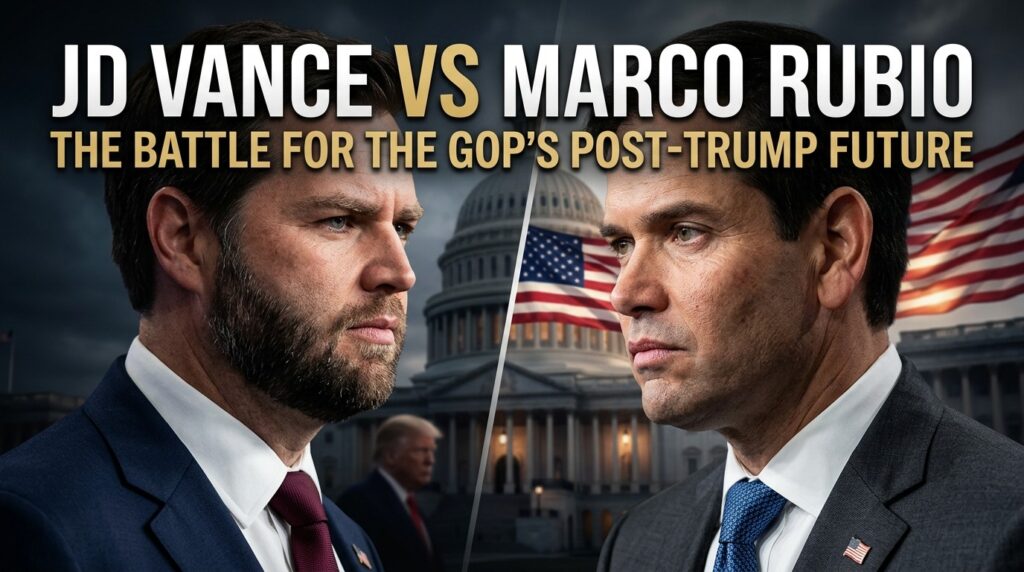
As Donald Trump’s final presidential term moves forward, the Republican Party faces an inevitable question: who takes over when he leaves office? Vice President JD Vance and Secretary of State Marco Rubio have emerged as the primary contenders fighting to shape the future of the conservative movement. This ideological collision holds significant implications for global trade, South Asian diplomacy, and Pakistan’s long-term relations with Washington.
- Constitutionally Barred: Donald Trump cannot seek a third presidential term, setting up an open primary in 2028.
- Leading Contenders: Recent primary polls show Vice President JD Vance leading potential GOP candidates with 43% support, followed by Secretary of State Marco Rubio at 21%.
- Divergent Visions: Vance champions economic populism and non-interventionism, whereas Rubio pushes traditional hawkish internationalism framed through modern conservative realism.
The Succession Crisis Behind Trump’s MAGA Movement
The Republican Party is approaching a major transition. Donald Trump transformed conservative politics over the last decade, replacing old-school corporate Republicanism with a nationalist, working-class platform. Because Trump cannot run again, party faithful must now pick a standard-bearer.
Will the political movement shift toward populist protectionism or lean back into traditional foreign interventionism?
That question is driving the growing rivalry between Vance and Rubio. Both men serve inside the cabinet, yet they hold distinctly different political visions. Delegates at the recent Republican Midterm Convention in Dallas cheered Vance’s speeches, signaling his solid grip on the activist base.
JD Vance: The Nationalist Heir Presumptive
JD Vance commands the populist wing. The author turned politician rose from a working-class background in Ohio to reach the vice presidency, building deep credibility among working-class voters along the way.
Vance rejects the old Reagan-era consensus. He argues against free-trade agreements, favors tariffs to protect American industrial labor, and demands a sharp pull-back of American military commitments abroad.
Vance advocates an “America First” stance that limits foreign involvement. His platform questions heavy foreign aid allocations while prioritizing domestic manufacturing.
For Pakistan, a Vance-led administration would mean dealing with a strictly transactional White House. Strategic security alliances would likely matter far less to his foreign policy advisors than direct economic trade arrangements.
Marco Rubio: Conservative Realism with Global Reach
Marco Rubio represents a contrasting vision of American leadership. The veteran politician from Florida has evolved since his early days in the U.S. Senate, adapting his messaging to align with current party dynamics.
Rubio argues that foreign policy cannot simply be ignored. As Secretary of State, he focuses heavily on counterbalancing major global powers, particularly maintaining a strong military presence in key strategic regions.
Rubio supports a assertive global foreign policy. He views strong security alliances across Asia and the Middle East as necessary tools to protect American interests.
Pakistani foreign policy experts follow Rubio’s trajectory closely. Rubio’s policies would likely maintain established military-to-military engagement channels, contrasting with Vance’s preference for pulling back on foreign ties.
Clash of Ideologies: Isolationism Meets Hegemony
The conflict between Vance and Rubio is far deeper than personal ambition. It represents a debate over what the Republican Party stands for.
Vance favors trade tariffs, reduced troop presence abroad, and severe cuts to foreign economic aid. Rubio advocates strategic interventionism, targeted economic sanctions, and maintaining established global alliances.
How will this impact global stability?
If Vance prevails, Washington may move toward semi-isolationism, forcing regional nations to carry their own security burdens. If Rubio wins, the U.S. will likely double down on global alliances to contain strategic competitors.
| Key Area | JD Vance’s Vision | Marco Rubio’s Vision |
| Foreign Policy | Non-interventionist, focus on domestic issues | Hawkish, active global engagement |
| Trade Stance | Protectionist tariffs, anti-globalization | Strategic trade agreements, economic pressure |
| South Asia Strategy | Minimal involvement, bilateral transactions | Balance of power alliances, security aid |
What This Republican Shift Means for Pakistan
Islamabad monitors American political rivalries carefully. Shifts in Washington directly affect South Asian security dynamics, International Monetary Fund (IMF) bailouts, and diplomatic relations across the region.
Under Vance, Pakistan would encounter a purely transaction-based relationship. Washington would likely prioritize specific border security guarantees over general foreign assistance packages.
Under Rubio, Washington would likely focus more heavily on regional counterterrorism operations. That approach could bring clearer demands, but it would also mean more stable diplomatic communication channels for Pakistani security officials.
The contest between JD Vance and Marco Rubio highlights a major turning point for the Republican Party. As Donald Trump’s presidency enters its final stretch, these two leaders present fundamentally different paths forward. Whether voters choose Vance’s nationalist populism or Rubio’s assertive internationalism, the winner will shape American domestic and foreign policy for years to come