
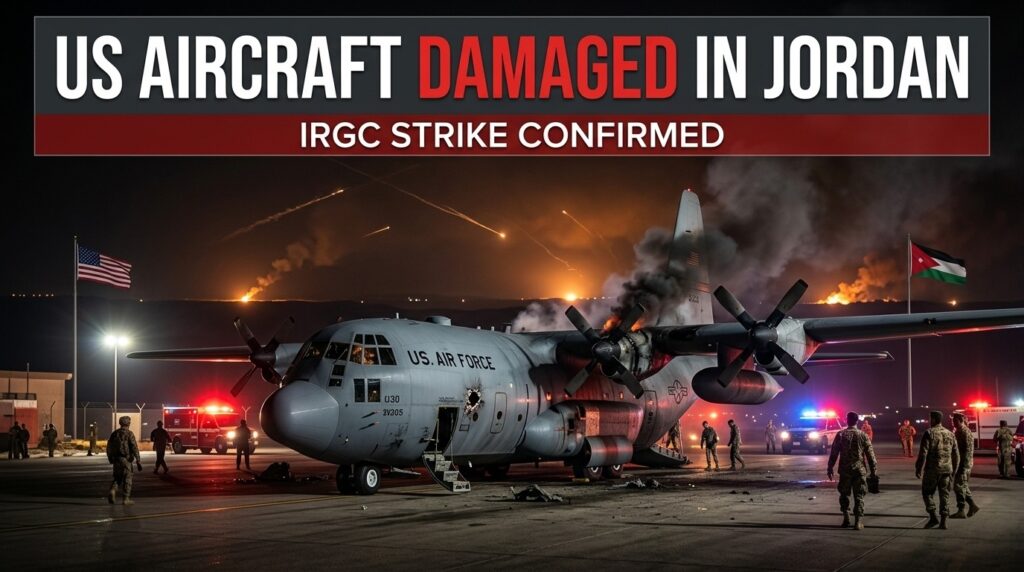
A senior United States official has confirmed that an Iranian Islamic Revolutionary Guard Corps (IRGC) strike caused material damage to multiple American military aircraft stationed at Muwaffaq Salti Air Base in Jordan. The attack hit one A-10 Thunderbolt II attack aircraft—commonly known as the “Warthog”—leaving it with a sheared-off wing, while approximately eight F-15 strike fighters sustained light damage. The acknowledgment highlights the persistent ability of Iranian ballistic missiles to penetrate sophisticated defensive perimeters during the ongoing regional conflict.
The barrage triggered an intense air defense response, forcing American batteries stationed in Jordan to launch roughly 30 MIM-104 Patriot interceptor missiles to shield the military installations. The incident comes amid growing strategic concern in Washington regarding the rapid depletion rate of high-end anti-missile munitions reserves across Middle Eastern theaters. For South Asian nations including Pakistan, the intensifying exchange of direct military strikes between Washington and Tehran presents sharp challenges for regional trade security, energy costs, and diplomatic positioning.
Escalatory Cycle Follows Maritime Confrontation
The IRGC attack on the installation near Al Azraq, Jordan, followed a sharp military escalation in surrounding waters. Hours earlier, US forces carried out strikes destroying five Iranian crude oil tankers. Washington stated those actions were taken after the IRGC targeted a US Navy warship with ballistic missiles twice over a two-day span.
SUMMARY OF AIR BASE IMPACT & ENGAGEMENT METRICS
———————————————————————-
Military Asset / Parameter Assessed Impact Status
———————————————————————-
A-10 Thunderbolt II (“Warthog”) Severely Damaged (Lost Wing)
F-15 Fighter Jets ~8 Aircraft (Light Damage; Operational)
Defensive Interceptors Fired ~30 Patriot Missiles Deployed
Targeted Facility Muwaffaq Salti Air Base, Jordan
Tactical Catalyst US Destruction of 5 Iranian Oil Tankers
———————————————————————-
(Sources: US Defense Official Statements / Reports)
Following the US action against the oil tankers, the IRGC launched a coordinated salvo of ballistic missiles and unmanned aerial vehicles targeting major bases supporting American military operations in the Levant. While Jordanian air defenses intercepted a portion of incoming projectiles, several warheads breached outer defensive shields, causing direct impacts inside the airfield perimeter. Technicians managed to repair and return the eight damaged F-15 fighters back into active operational service shortly after the assault.
Munition Depletion Concerns Mount in Washington
The engagement has reignited debate inside defense policy circles over the long-term sustainability of American air defense inventories. Discharging 30 Patriot interceptors during a single localized attack underscores how rapidly modern high-intensity engagements consume advanced surface-to-air missile stockpiles.
“The requirement to expend dozens of high-end interceptors against incoming salvos highlights a structural challenge. Air defense stockpiles face heavy pressure when tasked with blunting repeated missile volleys across multiple fronts,” noted a defense analyst specializing in Middle Eastern security.
Independent studies by defense think tanks, such as the Center for Strategic and International Studies (CSIS), estimate that a substantial percentage of total US Patriot inventories have been expended across Middle Eastern deployment zones since early 2026. Rebuilding these specialized missile stockpiles requires multi-year production cycles, creating potential logistical constraints for coalition forces operating in contested air space.
Strategic Implications for Regional Stability
The direct exchange of firepower between American forces and the IRGC in Jordan represents an expansion of regional conflict boundaries beyond immediate maritime choke points. For Pakistan, which shares a land border with Iran and maintains critical trade routes through adjacent waters, the structural widening of hostilities introduces severe economic risks.
Continued warfare destabilizes regional supply chains, pushing up global oil prices and elevating marine cargo insurance rates across the Arabian Sea. Pakistani policymakers are monitoring the situation closely, recognizing that sustained disruptions in energy infrastructure and transit corridors threaten domestic inflation targets and foreign exchange reserve stability. Islamabad continues to urge international de-escalation, advocating for diplomatic mechanisms to prevent full-scale regional conflict.
Key Facts
- Damage Confirmed: A US official confirmed an Iranian IRGC missile strike hit Muwaffaq Salti Air Base in Jordan.
- Aircraft Affected: One A-10 Thunderbolt II lost a wing; eight F-15 strike fighters suffered minor damage and were restored to service.
- Air Defense Activity: US forces fired approximately 30 Patriot interceptor missiles during the attack.
- Trigger Event: The strike followed US actions that destroyed five Iranian crude oil tankers.
- Stockpile Pressure: The rapid expenditure of Patriot interceptors highlights growing strain on US air defense inventories.
The confirmation of aircraft damage at Muwaffaq Salti Air Base in Jordan underlines the mounting intensity of direct military exchanges between the United States and Iran. As both sides trade strikes against military facilities and commercial maritime assets, the heavy consumption of defensive munitions underscores the high operational cost of sustained warfare. For Pakistan and global markets, de-escalation remains urgent to protect regional transit and economic stability