
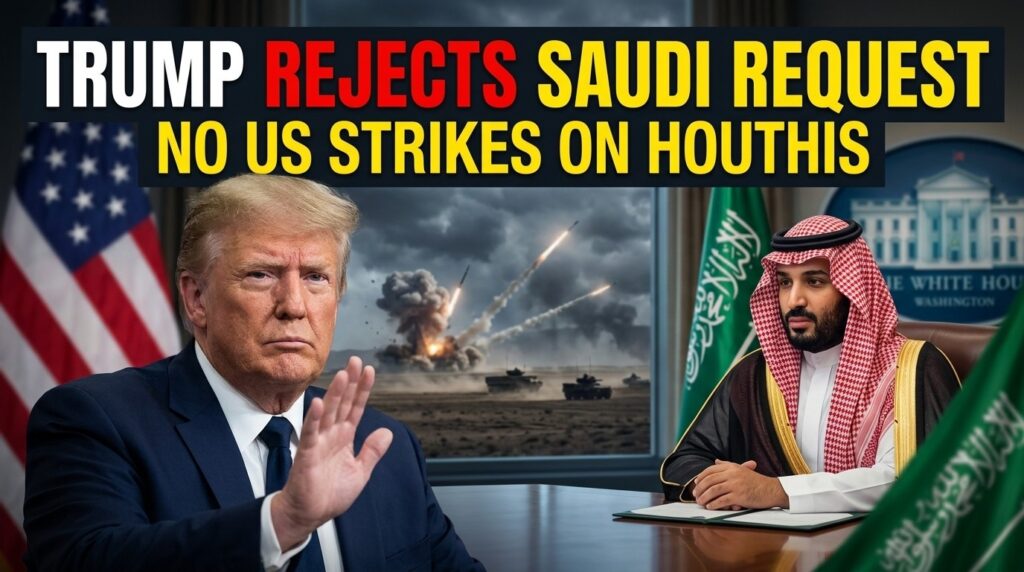
US President Donald Trump has declined urgent appeals from Saudi Crown Prince Muhammad bin Salman for direct American air strikes against Houthi forces in Yemen. The refusal came during high-level telephone discussions after the Iranian-backed group captured strategic positions near key Red Sea shipping lanes. While Washington opted against direct kinetic military action, US officials confirmed the deployment of intelligence sharing, targeting assistance, and non-kinetic military support to reinforce Saudi forces.
The diplomatic exchange highlights a distinct shift in Washington’s Middle East strategy, emphasizing regional burden-sharing over direct US military interventions. For South Asian nations including Pakistan, the expanding friction around crucial Arabian Sea and Red Sea maritime corridors underscores mounting vulnerabilities across international supply routes and regional security architectures.
Direct Appeals from Riyadh Rebuffed by Washington
Saudi Crown Prince Muhammad bin Salman made two direct telephone calls to US President Donald Trump urging the United States to launch air strikes against Houthi positions. The requests followed a sudden escalation in Western Yemen, where Houthi forces captured the strategic Red Sea coastal city of Mocha, raising fears of renewed disruptions near the Bab al-Mandab Strait.
U.S.-SAUDI MILITARY ASSISTANCE MATRIX (SEPTEMBER 2026)
———————————————————————-
Operational Category Status / Allocation
———————————————————————-
Direct US Air Strikes Declined by Administration
US Military Personnel On-Ground ~200 Non-Kinetic Advisers
Intelligence & Targeting Data Active US Operational Support
Senior Military Coordination CENTCOM Commander Visit to Riyadh
Primary Maritime Risk Focus Bab al-Mandab & Red Sea Shipping
———————————————————————-
(Sources: US Defense Department briefing reports / Regional diplomatic dispatches)
Despite intensive lobbying from Riyadh, the Trump administration made clear that the United States does not currently intend to engage in direct offensive combat operations against Houthi targets. Senior American officials noted that while Washington remains committed to defending strategic allies, the administration expects regional partners to lead kinetic efforts on the ground.
Intelligence Sharing and Non-Kinetic Support Continue
While ruling out direct bombardment, the White House agreed to bolster non-kinetic operational assistance. Commander of US Central Command (CENTCOM), Admiral Brad Cooper, traveled to Saudi Arabia for emergency consultations with senior defense leadership. The coordination framework focuses on providing real-time intelligence data, Houthi position tracking, and targeting logistics.
“The United States remains committed to regional stability and the defense of key partners, but regional military forces are best positioned to conduct active kinetic engagements on their domestic frontlines,” stated a senior US administration official.
Approximately 200 US military advisers are stationed in Saudi Arabia to support logistical planning and missile defense integration. Following the US decision, Saudi forces initiated a series of over 40 independent air strikes against Houthi military sites in response to attacks launched from the Yemeni mainland.
Strategic Implications for Maritime Trade
The reluctance of Washington to engage directly in air strikes against Houthi targets marks a turning point in Gulf security dynamics. With Houthi fighters making tactical gains around Mocha, commercial shipping through the Bab al-Mandab Strait faces heightened uncertainty, compounding global logistical delays already experienced across Persian Gulf trade routes.
The persistent instability along the Arabian Sea and Red Sea maritime corridors poses tangible economic risks. Islamabad relies heavily on secure trade routes through these waters for its petroleum imports, commercial exports, and vital supply chain linkages with Middle Eastern and European markets. Foreign policy experts in Islamabad emphasize that prolonged conflict in Yemen could drive up global shipping rates, elevate war risk insurance premiums, and exacerbate domestic inflationary pressures across South Asia. Pakistan continues to advocate for diplomatic resolution, de-escalation, and international maritime freedom to protect regional economic stability
President Donald Trump’s refusal to launch US air strikes against the Houthis highlights a firm policy shift toward regional self-reliance in Middle Eastern defense. While Washington continues providing intelligence and logistical backing to Riyadh, the burden of containing Houthi advances now rests squarely on Saudi Arabia and its regional allies. For Pakistan and global markets, achieving maritime security along Red Sea supply routes remains a priority to prevent widespread economic disruption
- Request Rejected: US President Donald Trump declined Crown Prince Muhammad bin Salman’s request for direct US air strikes on Houthis.
- Intelligence Support: Washington agreed to supply real-time targeting data, surveillance intelligence, and non-kinetic assistance.
- Advisory Presence: Approximately 200 US military personnel remain in Saudi Arabia offering non-combat support.
- CENTCOM Engagement: CENTCOM Commander Adm. Brad Cooper visited Riyadh for emergency defensecoordination.
- Catalyst for Appeal: Houthi forces advanced toward Mocha, threatening commercial movement near the Bab al-Mandab Strait.