
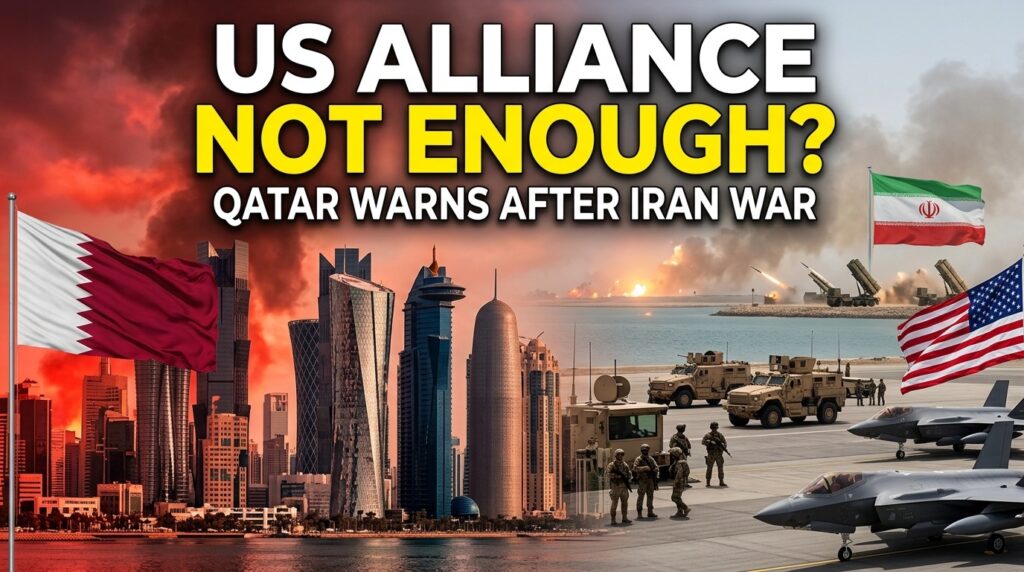
In the aftermath of intensifying regional conflict and cross-border exchanges involving Iran, Qatar has delivered a sobering assessment of Gulf security: while its long-standing strategic defense partnership with the United States remains vital, reliance on American military protection alone is no longer sufficient to guarantee stability in the Persian Gulf.
Doha’s stance highlights a major recalibration among Gulf Cooperation Council (GCC) nations. As regional infrastructure and commercial sea lanes face unprecedented disruption, Arab Gulf monarchies are shifting toward multi-vector diplomacy, regional de-escalation, and independent security measures to protect their sovereign interests.
- Strategic Reassessment: Qatar emphasizes that hosting Western military bases does not fully shield Gulf nations from regional retaliation or economic fallout.
- Al Udeid Air Base: Home to the largest US military installation in the Middle East, Qatar remains a key US ally but seeks broader diplomatic leverage.
- Energy Disruptions: Disruptions in the Strait of Hormuz—through which nearly 20% of global liquefied natural gas (LNG) and seaborne crude oil transit—have highlighted vulnerabilities in global energy supply chains.
- Diplomatic Balancing: Qatari officials continue to pursue mediation efforts with Tehran to restore regional balance and prevent total economic paralysis
The Basing Paradox: Why American Hardware Is Not Enough
For decades, the foundation of security across Gulf monarchies rested on an implicit bargain: host American troop deployments and military installations in exchange for absolute security guarantees against external aggression. Qatar’s Al Udeid Air Base, serving as the forward operational hub for US Central Command (CENTCOM), represented the pinnacle of this alignment.
However, military engagements between the US, Israel, and Iran have exposed what defense analysts call the “basing paradox”. While hosting US military assets deters full-scale invasions, it simultaneously transforms host countries into prime targets for Iranian missile strikes and drone barrages whenever regional hostilities ignite.
Furthermore, Gulf leadership noted that hosting rights failed to grant them operational veto power over Washington’s unilateral military choices. This dynamic left GCC states vulnerable to severe retaliatory collateral damage without input into the escalation decisions that triggered it.
Strait of Hormuz Crisis and Economic Vulnerabilities
Beyond direct military strikes, Qatar’s existential exposure stems from its economic reliance on energy exports. Responsible for roughly 19% of global LNG exports, Qatar relies heavily on unhindered access through the Strait of Hormuz.
When maritime transit through the narrow waterway ground to a crawl due to military blockades, drone threats, and naval skirmishes, Western naval escorts could only partially restore commercial throughput. The economic bottlenecks underscored that military force alone cannot preserve commercial stability when geography dictates permanent proximity to Iran.\
Shift Toward Regional De-Escalation and Coexistence
Recognizing that regional escalation jeopardizes vision-based national economic transformations, Qatar—alongside Saudi Arabia and the UAE—has increasingly favored coexistence over confrontation.
Doha has repeatedly utilized its unique diplomatic position to maintain open lines of communication with Tehran. Even after absorbing retaliatory strikes, Qatari leadership pursued quiet mediation visits to Tehran to de-escalate tensions and restore transit rights in the Gulf.
Rather than seeking to isolate Iran, Gulf capitals are pursuing a strategy aimed at establishing a durable regional security framework that relies on regional dialogue rather than external military intervention.
Strategic Implications for Pakistan
The evolving dynamics in the Gulf carry direct economic and geopolitical implications for Pakistan:
- Energy Security: Pakistan imports significant quantities of LNG from Qatar under long-term contracts. Any sustained disruption in the Gulf directly threatens Pakistan’s domestic power grid and industrial output.
- Remittances and Expatriates: Millions of Pakistani workers reside across Qatar, Saudi Arabia, and the UAE. Escalating conflicts in the Middle East place worker safety and critical foreign remittance inflows at risk.
- Diplomatic Neutrality: Islamabad maintains close defense ties with Saudi Arabia and Qatar while sharing a direct land border with Iran. Pakistan has consistently advocated for diplomatic resolutions, offering mediation services to prevent wider regional destabilization.
A New Era of Gulf Strategic Autonomy
Qatar’s assertion that the US alliance is “important, but not enough” signals a fundamental transition in Middle Eastern geopolitics. The limits of outsourced security have forced Gulf nations to balance traditional defense ties with active diplomatic engagement and broader regional partnerships. For Qatar and its GCC neighbors, long-term security will ultimately depend on building a stable framework of coexistence with all regional powers.