
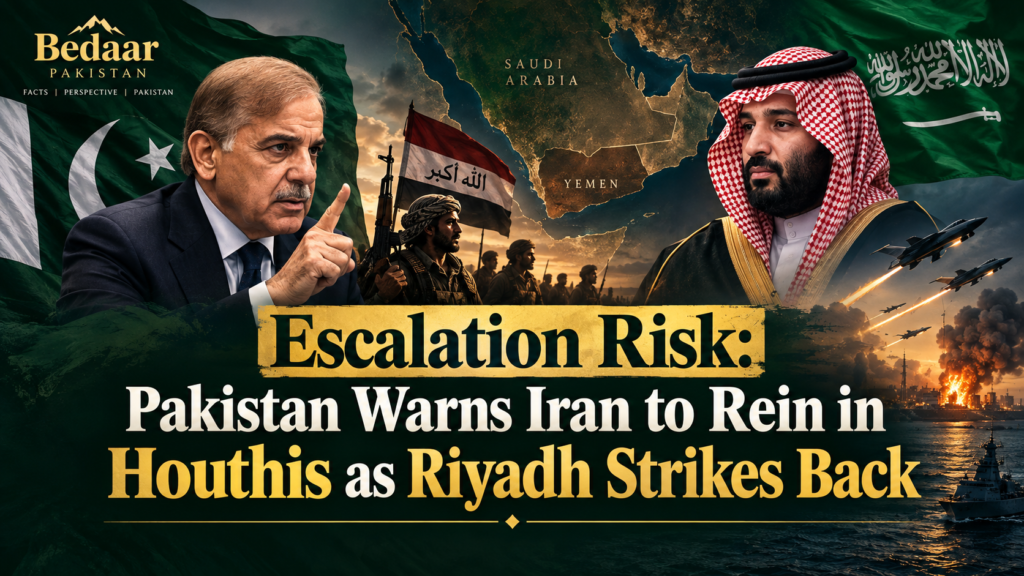
ISLAMABAD — Pakistan has delivered a direct diplomatic warning to Iran, urging Tehran to restrain Yemen’s Houthi militia following a sharp escalation in cross-border missile and drone strikes against Saudi Arabia. Addressing the deteriorating regional stability on national television, Pakistani Defense Minister Khawaja Asif warned that continued spillover of attacks into Saudi territory could trigger the newly established tripartite mutual defense framework between Islamabad, Riyadh, and Ankara. Pakistan’s warning carries significant weight as it signed a defense pact with Saudi Arabia, Türkiye last month, establishing a collective security arrangement that treats an attack against one member state as an aggression against all three.
- Diplomatic Action: Pakistan formally urged Tehran to use its influence to halt cross-border Houthi strikes on Saudi Arabia.
- Incident Trigger: Houthi drone and missile attacks targeted civilian and energy sites in Khamis Mushait, Abha, Jazan, and Najran, wounding 73 people.
- Mutual Defense Clause: Pakistani Defense Minister Khawaja Asif stated that unprovoked aggression against Saudi Arabia could trigger the Mecca Joint Defense Agreement.
- Trilateral Alliance: The Mecca Joint Defense Agreement was signed on August 7, 2026, by Pakistan, Saudi Arabia, and Türkiye.
- Operational Rules: Tripartite military coordination in Riyadh confirmed any defense operations would be launched from Saudi territory, with no ground troops entering Yemen.
- Retaliation Scale: Saudi air forces conducted 54 airstrikes against Houthi targets across Yemeni provinces over a 12-hour period following the strikes.
Strategic Shift: The Mecca Joint Defense Agreement and Regional Stakes
For decades, Pakistan has maintained a delicate balancing act in its foreign policy, preserving close economic and military ties with Saudi Arabia while managing a complex 900-kilometer shared border with Iran. However, the recent signing of the Mecca Joint Defense Agreement on August 7, 2026, alongside Saudi Arabia and Türkiye, has significantly altered Islamabad’s security posture in Middle Eastern dynamics.
The defense framework—whose Strategic Political and Defense Committee convened its inaugural meeting in Istanbul on August 31, 2026—establishes explicit mutual defense commitments among the three participating nations. Under the terms of the treaty, any armed aggression directed at one signatory is legally recognized as an attack against all three.
Speaking on Geo News, Defense Minister Khawaja Asif underscored the operational reality of the security framework. “Under the trilateral agreement, any aggression against any of the three [countries] is regarded as an aggression against all. There is no ambiguity about that,” Asif stated. He added that unprovoked spillover into Saudi Arabia “will definitely make this agreement operational,” asserting that Islamabad would honor its security commitments if required.
Escalation in Khamis Mushait and Saudi Retaliation
The diplomatic warning followed a major wave of aerial strikes launched by the Iran-backed Houthi militia targeting southern Saudi Arabia. The attacks hit energy infrastructure and military assets near Khamis Mushait, as well as sites in Abha, Jazan, and Najran, leaving 73 people wounded. The operation marked one of the most severe direct strikes on Saudi municipal and energy infrastructure since regional hostilities escalated earlier this year.
In immediate response, the Royal Saudi Air Force launched a counter-offensive. Houthi military spokesman Yahya Saree confirmed that Saudi warplanes carried out 54 airstrikes across multiple provinces in Yemen within a 12-hour window, warning that the retaliatory campaign would face further counteractions.
Diplomatic sources confirmed that senior Saudi, Pakistani, and Turkish military officials convened in Riyadh to coordinate their defense posture. According to officials familiar with the discussions, the three nations agreed that any military response under the alliance framework would remain defensive and operated strictly from within Saudi territory, explicitly ruling out the deployment of ground troops into Yemen.
Tehran’s Response and Diplomatic Maneuvering
Following Islamabad’s intervention, Iranian officials acknowledged receiving the message transmitted by Pakistani diplomatic emissaries. Tehran officially maintained that it does not exert operational command over Houthi military decisions, though regional intelligence sources indicate ongoing consultations between Iranian officials and Houthi leadership in Sanaa.
Regional security experts observe that Iran’s pressure campaign risks unintended geopolitical consequences. Rather than fracturing Western-aligned security networks, targeting Gulf state infrastructure has accelerated military cooperation between Saudi Arabia, Pakistan, and Türkiye.
Regional diplomats note that Islamabad is actively pursuing a diplomatic resolution to prevent the confrontation from reaching a threshold that necessitates direct military deployment under the Mecca pact. By positioning itself as a key diplomatic conduit, Pakistan aims to de-escalate regional tensions while reaffirming its security commitments to Riyadh.
The diplomatic warning delivered by Islamabad highlights a critical juncture in Middle Eastern security relations. As cross-border attacks threaten critical infrastructure in Saudi Arabia, Pakistan’s formal invocation of its tripartite defense obligations reflects the tangible weight of the Mecca Joint Defense Agreement. By asserting its willingness to honor mutual security commitments alongside Türkiye and Saudi Arabia, Pakistan has sent a clear message to Tehran and regional actors: preventing a wider conflict requires an immediate halt to proxy escalation against Gulf sovereignty