
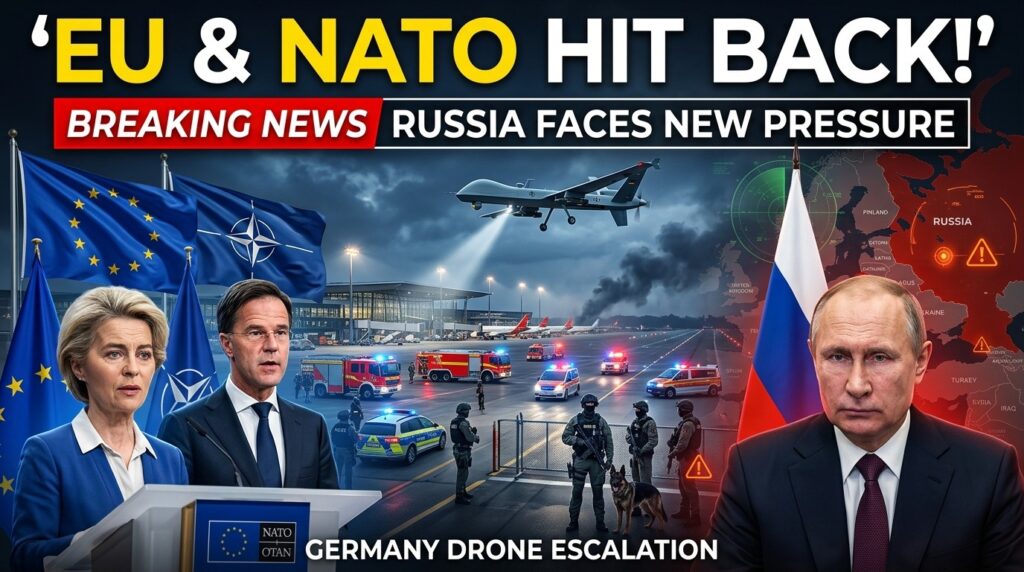
European and NATO leaders have united to intensify political, economic, and diplomatic pressure on Moscow following Germany’s formal attribution of an explosives-laden drone incident at Leipzig/Halle Airport to Russian state actors. European Commission President Ursula von der Leyen and NATO Secretary General Mark Rutte reaffirmed complete solidarity with Berlin, cautioning that Russia’s expanding pattern of hybrid warfare will trigger severe, coordinated countermeasures. As Western capitals prepare a fresh wave of sanctions and security clampdowns, the escalation underscores growing anxieties over European territorial security and the broader ramifications of the Russia-Ukraine conflict.
- Incidents at Leipzig Airport: On August 4, 2026, an explosive drone was discovered and defused near Ukrainian cargo aircraft at Leipzig/Halle Airport, a vital logistical hub for European trade and NATO military assistance.
- Official Attribution: German Interior Minister Alexander Dobrindt confirmed that forensic analysis of the drone’s detonator, components, and operational configuration directly tied the attempt to Russian state entities.
- Diplomatic Fallout: Germany ordered the closure of the Russian Consulate General in Bonn by September 18 and initiated the shutdown of the Russian House cultural center in Berlin.
- Western Countermeasures: The European Union is preparing its 22nd sanctions package targeting over 1,600 Russian-linked entities and stepping up interdictions against Russia’s shadow oil fleet.
- Moscow’s Response: Russian President Vladimir Putin denied involvement, claiming allegations were staged to distract from Western political and economic challenges.
Leipzig Drone Incident Triggers European Security Crisis
The formal announcement by Berlin regarding the August 4 failed attack at Leipzig/Halle Airport has pushed European security dynamics into a volatile new phase. Forensic technicians and bomb disposal teams defused an improvised explosive drone stationed near a heavy transport aircraft operated by Ukraine. Investigators noted that a second drone appeared to have collided with another transport aircraft, while a third drone was uncovered days later.
Addressing reporters in Berlin, German Interior Minister Alexander Dobrindt explained that the technological signatures—ranging from ignition mechanisms to physical build—mirrored hardware utilized in Russian operations elsewhere. Security analysts maintain that the intent was clear: to sabotage military and civilian logistical corridors supporting Kyiv and intimidate European nations providing defense aid.
EU and NATO Announce Coordinated Response
In response to the evidence presented by German investigators, Western military and political alliances have pledged a unified counteroffensive. NATO Secretary General Mark Rutte highlighted that European and Allied territory remains resolute, stating that “Russia has grown increasingly reckless,” but such attempts to divide Western partners would fail.
European Commission President Ursula von der Leyen characterized the attempt as an aggressive act of state-sponsored sabotage on European Union soil. Following emergency consultations between German Chancellor Friedrich Merz and European partners, EU Foreign Ministers began drafting comprehensive measures aimed at closing regulatory loopholes, restricting visa issuances for Russian nationals, and enhancing critical infrastructure monitoring across the bloc.
Berlin Closes Russian Outposts and Expands Sanctions
Germany’s diplomatic response was immediate. German Foreign Minister Johann Wadephul announced that the Russian Consulate General in Bonn will be stripped of its operational mandate by mid-September. Furthermore, authorities have moved to close the Russian House in central Berlin, an institution long suspected by intelligence agencies of serving as a hub for covert intelligence gathering and propaganda.
Beyond diplomatic expulsions, Berlin is lobbying its European partners to approve an expansive 22nd EU sanctions framework. This proposal aims to black-list over 1,600 corporations, financial entities, and high-ranking military figures. Simultaneously, North Sea and Baltic littoral states are coordinating maritime operations to board and inspect Russia’s “shadow fleet”—unflagged or loosely regulated oil tankers used to circumvent international price caps and generate revenue for Moscow’s war effort.
Moscow Rejects Allegations Amid Rising Regional Tensions
Kremlin officials dismissed the accusations, terming them groundless provocations. Speaking at a press conference following a regional summit, Russian President Vladimir Putin claimed the evidence cited by Berlin was “planted” and accused Western political leaders of manipulating public opinion to hide economic difficulties. Russian Foreign Ministry Spokesperson Maria Zakharova warned that Moscow would implement mirror-image measures against German diplomatic infrastructure.
The incident comes against a backdrop of heightened security alerts across Eastern and Central Europe, where cyberattacks, grid sabotage attempts, and mysterious drone sightings near military facilities have sharply increased.
The drone incident at Leipzig Airport represents a dangerous threshold in the escalating friction between Russia and Western nations. By moving decisively with diplomatic closures, stricter sanctions, and heightened military readiness, the EU and NATO are signaling that hybrid warfare attacks will draw direct, collective retaliation. As both sides harden their positions, the international community faces heightened uncertainty with far-reaching impacts on global trade, energy security, and international relations.