
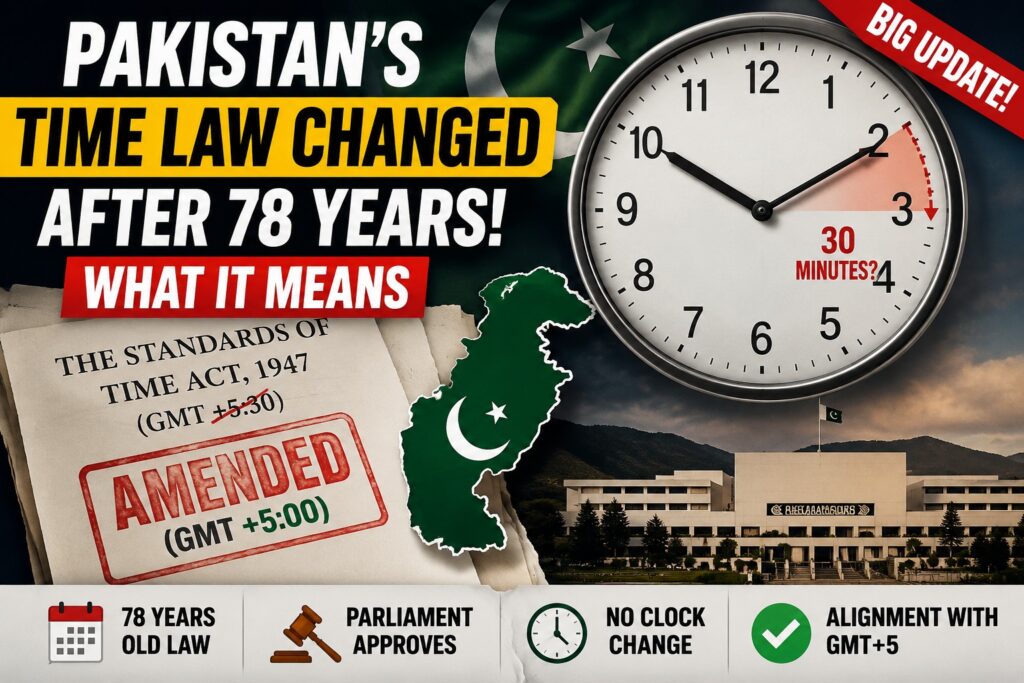
In a historic legislative milestone, Pakistan’s Parliament has officially passed a bill modifying the statutory framework governing Pakistan Standard Time (PKT) for the first time since the nation’s independence. The passage of this legislation resolves a longstanding discrepancy between colonial-era statutory codes and modern civil timekeeping practices. While public speculation suggested physical clocks might shift by 30 minutes, official documents confirm that daily schedules, civil clocks, and international operations will remain strictly on UTC+5:00.
- Legislative Action: Parliament passed a historic legal update clarifying the official statutory basis of Pakistan Standard Time.
- Historical Context: This marks the first comprehensive legal legislative alignment on national time standards in nearly 78 years.
- Time Zone Offset: Pakistan remains firmly anchored at UTC+5:00 (GMT+5).
- Public Impact: No manual clock changes or adjustments are required by citizens, businesses, or government offices.
- Legal Alignment: The amendment removes outdated statutory references stemming from the 1905 and 1947 pre-independence era
Demystifying the Legislation: Did Clocks Change by 30 Minutes?
Following the parliamentary approval of the new Pakistan Standard Time bill, widespread rumors suggested that citizen wall clocks and digital devices would adjust by 30 minutes to align closer to GMT+5:30. However, government officials and legal experts confirm that no physical time shift will occur.
The new law serves primarily as a legal correction rather than a chronological shift. Historically, pre-independence South Asia operated under Indian Standard Time (IST), established at UTC+5:30 based on the 82.5° East longitude. When Pakistan was founded in 1947, it initially maintained UTC+5:30 for four years before formally adopting UTC+5:00 (5 hours ahead of Greenwich Mean Time) in 1951 to better match its central meridian near Lahore (75° East longitude).
Despite adopting UTC+5:00 administratively decades ago, secondary legal statutes and statutory books continued to contain outdated provisions. The recent parliamentary act repeals obsolete language and provides formal legal authorization for UTC+5:00 as the sole statutory standard across all four provinces, Gilgit-Baltistan, and Azad Jammu & Kashmir.
Why the 78-Year Legal Gap Existed in Pakistan’s Gazette
The legal anomaly dates back to 1947. While executive orders shifted civil time to UTC+5:00 in September 1951, comprehensive federal codification had left minor statutory gaps regarding emergency protocols, civil aviation baseline times, and maritime time tracking.
For decades, Pakistan’s federal departments operated under administrative decrees. Legal scholars noted that updating primary legislation ensures that judicial proceedings, official gazette publications, international aviation contracts, and digital infrastructure rest on unambiguous federal law rather than cabinet executive orders.
Impact on International Business, Tech, and Aviation
For international trade, aviation, and global technology networks, standardizing time legislation without shifting offsets ensures seamless operational continuity.
Core Operational Sectors:
- Civil Aviation: Flight schedules logged under the international designator PKT (UTC+5:00) remain unchanged, preventing disruption across international airport hubs in Karachi, Lahore, and Islamabad.
- Banking and Financial Markets: Financial clearing houses, stock exchanges (PSX), and interbank transfers operate without requiring system re-synchronization.
- Information Technology & Telecommunications: Enterprise resource planning (ERP) systems, server timestamps, and cellular network protocols maintain their standard UTC+5 configuration without software patch deployments.
Comparing Pakistan Standard Time with Regional Time Zones
Pakistan’s location places it between Central Asia and South Asia. Its time offset reflects its geography and geopolitical boundaries:
| Country / Region | Time Zone Name | UTC / GMT Offset | Relationship to PKT |
| Pakistan | Pakistan Standard Time (PKT) | UTC+5:00 | Base Time |
| India | Indian Standard Time (IST) | UTC+5:30 | +30 Minutes |
| Iran | Iran Standard Time (IRST) | UTC+3:30 | -1.5 Hours |
| Afghanistan | Afghanistan Time (AFT) | UTC+4:30 | -30 Minutes |
| China | China Standard Time (CST) | UTC+8:00 | +3 Hours |
| UAE / Gulf | Gulf Standard Time (GST) | UTC+4:00 | -1 Hour |
What Pakistani Citizens Need to Do Today
For the average citizen, the passage of the Pakistan Standard Time bill requires zero manual intervention.
- Smartphones & Computers: Network Time Protocol (NTP) settings will remain locked to GMT+5:00.
- Daily Routines: Work hours, school timetables, railway operations, and prayer schedules continue under existing standard hours.
- Daylight Saving Time (DST): Pakistan does not observe seasonal clock shifts. The last experimental DST observation occurred in 2009.
The updated Pakistan Standard Time law represents a necessary modernization of the country’s legislative books. By formally solidifying UTC+5:00 into federal statute, Parliament has eliminated historic legal ambiguity while maintaining absolute stability for daily life, business operations, and international connectivity.