
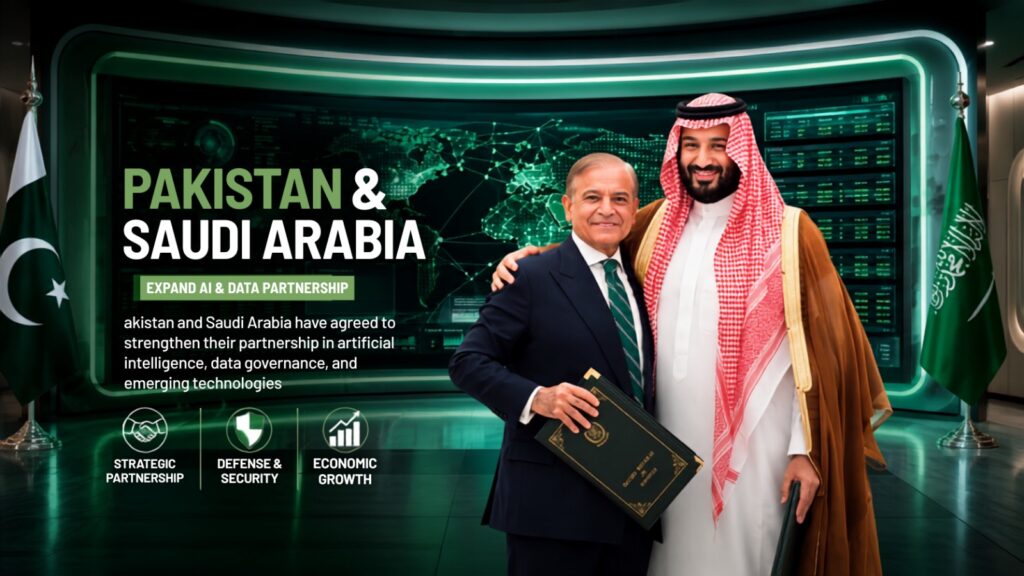
Pakistan and Saudi Arabia have agreed to strengthen and broaden their cooperation in artificial intelligence, data governance and emerging technologies, marking a further step in the two countries’ growing digital partnership. The agreement was reached in Riyadh during a meeting between Federal Minister for Information Technology and Telecommunication Shaza Fatima Khawaja and Saudi Data and Artificial Intelligence Authority (SDAIA) President Abdullah bin Sharaf Alghamdi on the sidelines of the LEAP 2026 technology conference. Both sides said they would work toward a comprehensive and sustainable framework covering AI, data governance and advanced technologies, building on earlier talks this year on expanding the two countries’ digital connectivity.
- Agreement reached on the sidelines of the LEAP 2026 conference in Riyadh, Saudi Arabia.
- Talks were held between Pakistan’s Federal Minister for IT and Telecommunication, Shaza Fatima Khawaja, and SDAIA President Abdullah bin Sharaf Alghamdi.
- Both sides agreed to work toward a comprehensive, sustainable partnership in AI, data governance and emerging technologies.
- Shaza Fatima briefed the SDAIA president on Pakistan’s ongoing national AI and data governance initiatives.
- Pakistan attended LEAP 2026 with its largest-ever delegation, under the theme “Think Tech, Think Pakistan.”
- The agreement builds on July 2026 talks in Geneva, where Pakistan and Saudi Arabia agreed to expand a bilateral “digital corridor,” including new submarine cables and terrestrial connectivity.
- Separately, Saudi-linked Magna AI signed an MOU with Pakistan’s Corvit Networks to advance sovereign AI infrastructure and workforce development in Pakistan.
- Industry estimates cited by the Saudi Data and AI Authority suggest AI could contribute up to 5.6% of GDP in economies comparable to Pakistan.
What the Riyadh Agreement Covers
According to Pakistan’s state broadcaster, the discussions in Riyadh centred on establishing a comprehensive and sustainable partnership between Pakistan and Saudi Arabia across artificial intelligence, data governance and advanced technologies. During the meeting, Shaza Fatima briefed Alghamdi on Pakistan’s ongoing initiatives related to its national AI and data governance agenda, and reaffirmed Pakistan’s commitment to building a strong data ecosystem and strengthening its digital economy. The two sides also discussed ways to continue working together on emerging technologies and to build a lasting framework for cooperation, according to a news release on the meeting.
The meeting took place as Pakistan sent its largest-ever delegation to LEAP 2026, one of the region’s major technology conferences, under the banner “Think Tech, Think Pakistan.” The scale of Pakistan’s presence at the Riyadh event reflects a broader push by Islamabad to position the country as a partner for Gulf investment in digital infrastructure, AI and data-driven development.
Part of a Wider Digital Push Between the Two Countries
The Riyadh talks follow a series of technology-focused engagements between Pakistan and Saudi Arabia in 2026. In July, Shaza Fatima met her Saudi counterpart, Communications and Information Technology Minister Abdullah Alswaha, on the sidelines of the AI for Good Global Summit in Geneva, where the two countries agreed to accelerate work on a bilateral “digital corridor,” including new submarine cables and stronger terrestrial connectivity networks. Pakistan and Saudi Arabia have traditionally cooperated on defence, diplomacy, labour and financial support; officials on both sides have said the relationship is now expanding into technology and digital infrastructure. Private-sector activity has moved in parallel with government talks. Magna AI, a sovereign AI transformation company formed through a partnership involving Trend Micro and Wistron Digital Technology Holding Company in collaboration with NVIDIA, signed a memorandum of understanding with Pakistani technology training and digital services firm Corvit Networks. The MOU sets out a framework to advance sovereign AI infrastructure, platforms and workforce capabilities across Pakistan’s government, enterprise and academic sectors. The announcement noted that AI could contribute up to 5.6% of GDP in economies comparable to Pakistan, according to a PwC report cited by the Saudi Data and AI Authority, with a potential AI-driven economic impact of $10–20 billion within Pakistan’s digital economy, which is projected to reach $60 billion by 2030. Globally, annual investment in AI-dedicated infrastructure is projected to reach $400 billion by 2030
The Riyadh talks add to a widening set of technology agreements between Pakistan and Saudi Arabia in 2026, spanning government-to-government cooperation on AI and data governance, digital connectivity infrastructure, and private-sector investment in sovereign AI capabilities. For Pakistan, the engagement forms part of a broader effort to attract Gulf investment into its digital economy and to build out national AI and data governance