
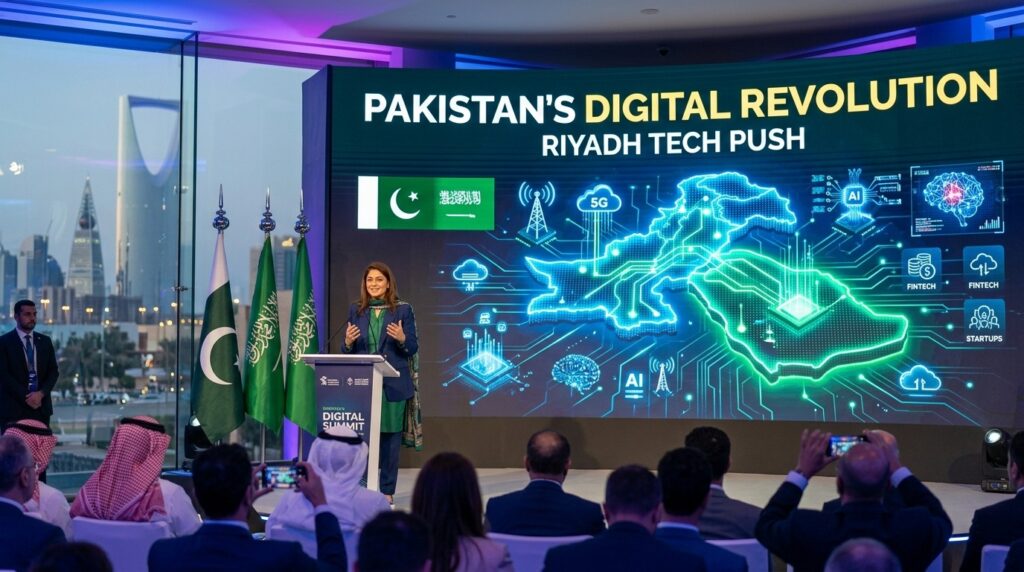
Pakistan has launched a aggressive international pitch in Riyadh, showcasing its fast-growing technology sector, artificial intelligence framework, and 5G readiness to global venture capitalists and tech conglomerates. Addressing international leaders at the LEAP tech conference in Saudi Arabia, Federal Minister for Information Technology and Telecommunication Shaza Fatima Khawaja emphasized the nation’s strategic pivot toward a digital-first economy under the “Tech Destination Pakistan” initiative. Anchored by recent legislative reforms and deep bilateral cooperation with Saudi Arabia, Pakistan aims to position its tech ecosystem as a prime hub for global investment and IT exports.
- Event & Location: LEAP Conference & Technology Summit, Riyadh, Saudi Arabia.
- Key Speaker: Shaza Fatima Khawaja, Federal Minister for Information Technology and Telecommunication.
- Core Legislative Anchor: Digital Nation Pakistan Act, establishing the National Digital Commission and Pakistan Digital Authority.
- Target: Escalating national IT exports to $25 billion over the next 5 years through international market access and capacity building.
- Key Focus Areas: Artificial Intelligence (AI) integration, 5G connectivity expansion, digital governance, and cross-border startup funding.
Pitching ‘Tech Destination Pakistan’ on the Global Stage
In a high-profile session in Riyadh, Federal IT Minister Shaza Fatima Khawaja presented Pakistan’s digital roadmap to an audience of international investors, tech executives, and government delegations. Highlighting the “Tech Destination Pakistan” campaign, she framed the country not merely as an IT service provider, but as a critical node for software development, cloud infrastructure, and emerging technologies in South Asia.
The delegation aimed to attract foreign direct investment by showcasing Pakistan’s expanding digital infrastructure and tech ecosystem. With a tech-savvy population where over 60 percent of citizens are youth, the Ministry of IT & Telecommunication (MoITT) highlighted the country’s high potential to meet global technical talent shortages. The pitch aligns with broader regional initiatives, connecting Pakistani enterprise solutions with the Middle East’s expanding technology investments.
Deepening Pakistan-Saudi Technology Cooperation
A central element of the Riyadh showcase is the accelerating bilateral technology partnership between Islamabad and Riyadh. Following high-level discussions with the President of the Saudi Data and Artificial Intelligence Authority (SDAIA), Dr. Abdullah bin Sharaf Alghamdi, both nations reaffirmed their commitment to deepen cooperation in AI, data governance, and cloud computing.
This bilateral alignment is directly linked to Saudi Arabia’s Vision 2030, which seeks to diversify the Kingdom’s economy through massive technology adoption. Joint initiatives already include joint tech hubs—such as the GO AI Hub inaugurated in Islamabad—and venture partnerships enabling Pakistani startups to scale directly into the Saudi enterprise market.
Institutionalizing Reforms via the Digital Nation Pakistan Act
Minister Shaza Fatima emphasized that Pakistan’s digital push is built on permanent legal and structural reforms. The recently enacted Digital Nation Pakistan Act provides a legal foundation designed to ensure policy continuity and streamline digital governance.
Under this legislative framework, two pivotal bodies were created:
- National Digital Commission: Oversees national digitization strategies, cross-sectoral tech integration, and sovereign data policies.
- Pakistan Digital Authority: Functions as the primary execution body to facilitate private-sector entry, streamline IT licensing, and enforce cybersecurity protocols.
These reforms aim to reassure foreign venture capitalists by minimizing bureaucratic delays, protecting intellectual property, and establishing transparent, international-standard data regulations.
Expanding Infrastructure: AI Policies, 5G, and Submarine Cables
To back its digital policy ambitions, Pakistan detailed significant infrastructure developments underway. Following the approval of the National AI Policy, the government has launched a structured six-pillar plan focused on talent development, R&D funding, and AI governance to transform the country into a regional AI hub.
To support AI processing demands, private-sector partners are deploying the country’s first Tier III, AI-ready data centers, while telecom regulators implement the “Zero Connectivity Disruption” initiative. Supported by new submarine cable landings like Africa-1, these measures aim to guarantee resilient, high-speed fiber connectivity essential for international business process outsourcing (BPO) and software development operations.
Driving Startups, Fintech, and Digital Skill Development
Beyond infrastructure, the Pakistani presentation centered on human capital and entrepreneurship. Through the Prime Minister’s SkillTech Pakistan initiative, executed via the Pakistan Software Export Board (PSEB), the government has targeted training over 430,000 young professionals in advanced digital disciplines like Machine Learning, Cloud Architecture, and Cybersecurity. Pakistani startups in fintech, enterprise resource planning (ERP), and software-as-a-service (SaaS) featured prominently at the Riyadh event. By securing equity partnerships with Gulf investment groups, local tech platforms are establishing a direct pipeline for cross-border digital payments and digital trade, strengthening the target to achieve $25 billion in IT export revenue.
Pakistan’s targeted presentation in Riyadh marks a deliberate transition from traditional export models to a structured, high-value tech economy. By pairing legal protections like the Digital Nation Pakistan Act with heavy investment in AI infrastructure, 5G readiness, and skill development, Islamabad is establishing a credible foundation for foreign investors. If supported by continuous policy stability and sustained bilateral partnerships with Gulf nations, Pakistan’s tech sector remains well-positioned to serve as a principal driver of the country’s broader economic recovery.