
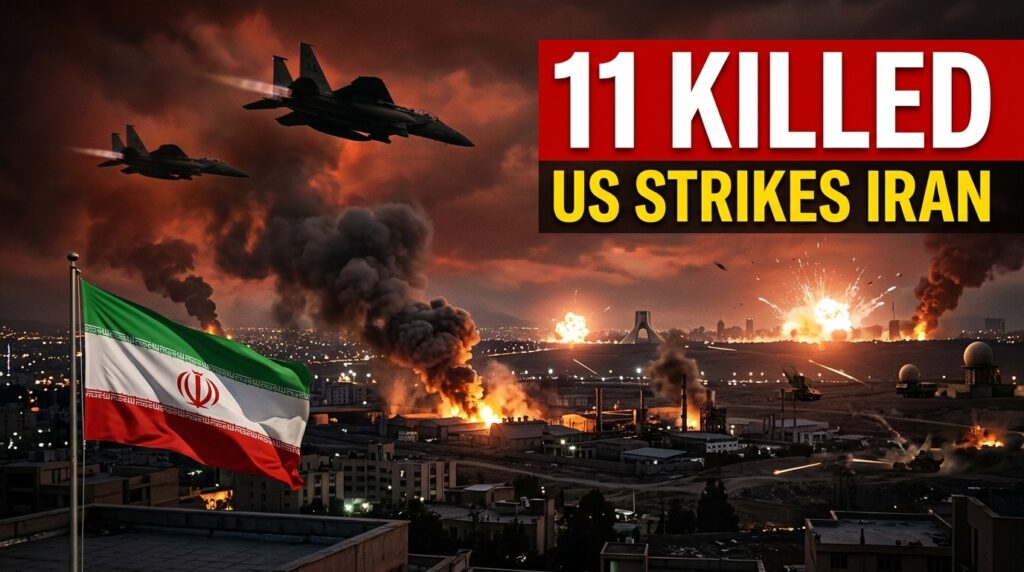
Tensions in the Middle East reached a dangerous flashpoint on Wednesday following a series of direct military confrontations between Washington and Tehran. Iranian state media reported that at least 11 people were killed in overnight US missile strikes targeting multiple locations within the country. The severe military escalation has drawn sharp international concern, with Pakistan closely monitoring the rapidly deteriorating security landscape along its western border regions and vital commercial sea lanes.
- Casualty Toll: 11 people confirmed dead by Iranian state media following missile strikes in Khuzestan province and Sirik county.
- Impact Zone: Overnight strikes targeted three locations in southwestern Khuzestan and coastal infrastructure near the Strait of Hormuz.
- Retaliation: Iran’s Islamic Revolutionary Guard Corps (IRGC) launched ballistic missiles targeting US military installations in Jordan, Bahrain, and Kuwait.
- Economic Shock: Global Brent crude oil futures jumped past $95 per barrel amid fears of maritime disruptions in the Persian Gulf.
Overnight Attacks Target Khuzestan and Coastal Sirik
According to statements carried by Iran’s official IRNA news agency, seven people were killed and eight others wounded when US forces launched precision missile strikes on three separate facilities in Khuzestan province overnight. Local security officials confirmed that emergency medical personnel were dispatched to clear rubble and treat survivors across affected residential and industrial areas.
The Khuzestan bombardment followed a separate deadly engagement reported by the Iranian Red Crescent in Sirik county, located along the strategic Strait of Hormuz. Officials reported four fatalities, including a four-year-old child, along with dozens of injuries after projectiles struck a residential area. The US Military’s Central Command (CENTCOM) stated its operation aimed to degrade IRGC assets that posed threats to commercial shipping and American service members in the region.
Tehran Vows ‘Devastating Blows’ as Missile Fire Exchanges Continue
In response to the domestic strikes, Iran’s Armed Forces Central Headquarters released a statement declaring that military forces would deliver severe counter-strikes against US assets. Within hours of the US bombardment, Iran’s Tasnim News Agency reported the launch of heavy ballistic missiles toward US locations, including Camp Titin in Jordan, as well as bases hosting allied personnel in Kuwait and Bahrain.
US military defense batteries were activated across multiple regional installations to intercept incoming projectiles. Washington warned that any continued Iranian counter-offensives would trigger significantly larger combat operations. The direct exchange marks one of the most serious direct military confrontations between the two nations in recent history, bypassing traditional proxy warfare in favor of direct state-on-state strikes.
Maritime Threats and Soaring Global Energy Prices
The spillover of the conflict into the Persian Gulf and the Strait of Hormuz—a transit point for nearly 20 percent of global petroleum—has sent shockwaves through global energy markets. Reports of naval skirmishes, maritime alerts in Bahrain, and attacks on commercial tankers caused Brent crude futures to surge over 0.8% to $95.40 a barrel during early trading hours.
Shipping companies have begun re-routing vessels away from the Gulf region due to heightened risks of sea-mine deployment and anti-ship missile activity. Insurance premiums for maritime cargo traveling through Middle Eastern shipping routes have spiked dramatically, compounding supply chain anxieties across Asian and European markets reliant on Gulf oil exports.
International Community Calls for Urgent De-escalation
World leaders and international bodies have voiced deep alarm over the direct escalation between Washington and Tehran. The United Nations urged both parties to exercise maximum restraint to prevent a wider regional conflict that could engulf neighboring states.
Diplomats in European capitals have initiated emergency consultations to establish communication channels between the warring parties. However, with missile exchanges continuing across multiple theater fronts, diplomatic efforts face significant hurdles as both nations maintain heightened military readiness.
The direct exchange of missile fire between the United States and Iran represents a dangerous evolution in Middle Eastern conflict dynamics. With 11 confirmed casualties inside Iran and retaliatory strikes reaching across regional borders, the crisis poses severe security and economic ramifications globally and within South Asia. As global energy markets react and regional borders tighten, all eyes remain on whether diplomatic channels can halt further escalation before the conflict expands into an uncontainable regional war.