
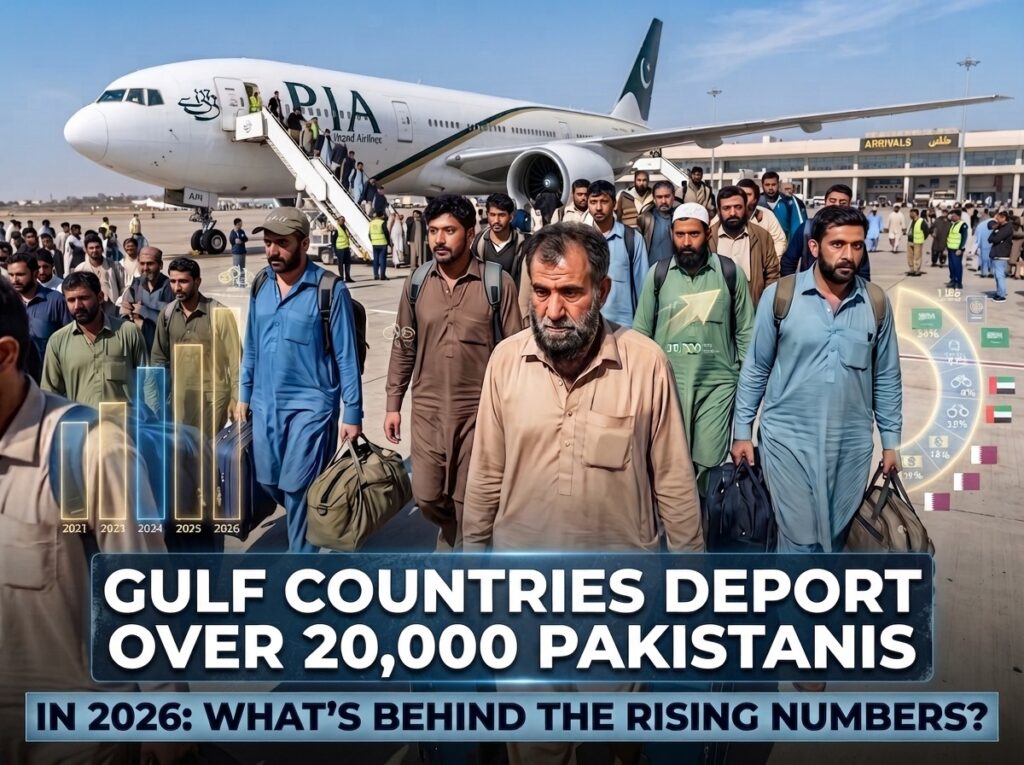
More than 21,000 Pakistanis were formally deported from Gulf countries between March 1 and July 13, 2026, according to figures presented to Pakistan’s National Assembly. Saudi Arabia accounted for the largest share, followed by the United Arab Emirates, while Oman, Bahrain, Qatar and Kuwait also recorded deportations. The figures highlight the immigration, legal and documentation risks faced by Pakistanis living and working across the Gulf.
- 21,951 Pakistani nationals were deported from Gulf countries between March 1 and July 13, 2026.
- Saudi Arabia: 15,495 deportations.
- UAE: 3,803 deportations.
- Oman: 1,606 deportations.
- Bahrain: 521 deportations.
- Qatar: 429 deportations.
- Kuwait: 97 deportations.
- Reasons included overstaying, illegal entry, begging, drug-related offences, forged documents, refused asylum, security concerns and other immigration violations.
- 4,628 absconders were deported, while 1,294 people were deported after being jailed.
- The data also recorded 968 blacklisted Pakistanis, 1,155 cases linked to lost passports and 689 deportations for visa violations.
Pakistanis Deported From Gulf Countries: What the Latest Data Shows
The latest figures were disclosed in a written response during Question Hour in the National Assembly on August 20. The total of 21,951 covers formal deportations reported to Pakistani authorities.
The figures should not be interpreted as meaning that all Pakistani nationals returning from the Gulf were deported. Parliamentary Affairs Minister Tariq Fazal Chaudhry clarified that the official count covers people formally detained by authorities in host countries and deported after Pakistani missions issued emergency travel documents. Pakistanis who returned voluntarily or travelled on valid passports were not included.
This distinction matters because deportation and voluntary return are not the same. A person formally removed after an immigration or legal violation is counted differently from someone who leaves the Gulf voluntarily.
Saudi Arabia Leads the Deportation Figures
Saudi Arabia recorded the largest number of Pakistanis deported, with 15,495 cases during the reported period. The UAE followed with 3,803, while Oman recorded 1,606. Bahrain accounted for 521 deportations, Qatar for 429 and Kuwait for 97.
The country-wise figures show that Saudi Arabia and the UAE together accounted for most of the reported cases.
The government data also provides details about some categories. Saudi Arabia deported 3,921 Pakistani absconders, while the UAE deported 636. Saudi Arabia also recorded 1,924 deportations linked to overstay or illegal entry, compared with 347 in the UAE and 295 in Oman.
Why Are Pakistanis Being Deported?
The reasons behind Pakistani deportation vary and should not be reduced to one cause. The government response listed overstaying, illegal entry, begging, drug-related offences, forged documentation, refused asylum and security-related reasons, among other violations.
Absconding is another significant category. The National Assembly data recorded 4,628 deported absconders. The term generally refers to workers reported as having left employment or violated residency-related conditions.
Documentation problems also feature in the figures. There were 1,155 deportation cases involving lost passports, while 689 Pakistanis were deported for visa violations. Another 342 cases involved people refused entry into Gulf states.
The response also listed 472 Pakistani beggars among those deported. Nine Pakistanis were deported from the UAE through Interpol. Other cases involved expired iqamas or passports, impersonation, theft and immigration-law violations.
Is There Really a “Rising” Deportation Trend?
The latest figure is significant, but the available data needs to be read carefully before describing it as a continuous rise.
An earlier National Assembly document covering January 2021 to April 2026 recorded 164,788 deportees from GCC countries over that longer period, including 13,585 in 2026 through April.
Those figures cover different periods, so they cannot simply be added together or used alone to establish a year-on-year trend. The newer March-to-July data does, however, show that formal Pakistani deportations remain a substantial issue in the Gulf.
For Pakistan, the issue matters beyond immigration statistics. Millions of Pakistanis live and work in Gulf states, making the region an important destination for overseas employment and a major source of remittances. Deportations can therefore affect workers, families and communities in Pakistan.
What Pakistani Workers Should Know
For Pakistanis planning to work or live in the Gulf, the figures underline the importance of following local immigration and employment rules. Workers should keep residency permits, passports and visas valid, understand the conditions attached to their employment and avoid activities that can lead to criminal or immigration proceedings.
Those facing disputes with employers should seek help through official Pakistani missions and relevant labour authorities rather than leaving employment without understanding the consequences. Lost passports and expired residency documents can create additional complications.
The deportation figures should also not be interpreted as evidence that Gulf states are targeting Pakistanis as a group. The government data identifies legal, immigration and administrative grounds behind the cases, while the reasons differ from one individual to another.
For families in Pakistan, the practical lesson is straightforward: overseas employment offers important economic opportunities, but workers need to understand the laws of the country where they live.
Why were Pakistanis deported from Gulf countries?
Reported reasons included overstaying, illegal entry, begging, drug-related offences, forged documents, refused asylum, security concerns, visa violations, absconding and other breaches of local immigration laws.
Does the figure include Pakistanis who returned voluntarily?
No. The government clarified that the official figure covers formal deportations. Pakistanis who returned voluntarily or travelled on valid passports were not included.
Does this mean Gulf countries are deporting Pakistanis without reason?
No. The available government data identifies legal, immigration, documentation and other specific grounds for deportation. The figures do not establish that Pakistanis are being removed without cause.
The 21,951 Pakistanis deported from Gulf countries between March 1 and July 13, 2026, represent a significant immigration and overseas-employment story for Pakistan. Saudi Arabia and the UAE accounted for most reported cases, while absconding, immigration violations, documentation problems and other legal issues featured prominently.
The figures also require context: formal deportations are not the same as voluntary returns, and the available reporting periods do not prove a simple year-on-year increase. For Pakistani workers and families, the clearest message is the importance of valid documents, lawful employment and compliance with the rules of the host country.