
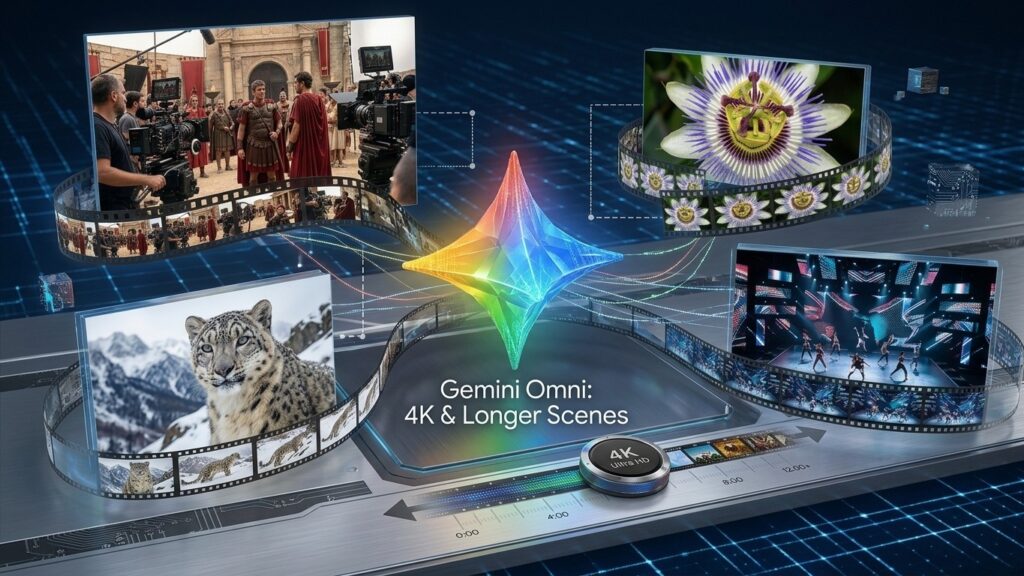
Google has rolled out Gemini Omni 1.1 Flash, an upgraded version of its AI video generation model that adds 4K upscaling, longer scene extensions and finer creative controls. The update, announced on Thursday, lets creators stretch AI-generated clips to 40 seconds and lock the first and last frame of a shot to guide the motion in between. It is now available to developers through Google AI Studio and is rolling out globally to Google AI Plus, Pro and Ultra subscribers via Google Flow and the Gemini app.
- Gemini Omni 1.1 Flash was announced on Thursday, August 27, 2026, following the original Gemini Omni Flash introduced at Google I/O in May 2026.
- Scene extension now analyses up to 10 seconds of prior footage for context, compared with roughly one second in the earlier model.
- Videos can be extended in 10-second increments up to a cumulative maximum of 40 seconds.
- The model supports first-and-last-frame interpolation, letting creators set a starting and ending image and have Gemini generate the motion between them.
- Video references of up to three seconds can be supplied to help the model keep characters and visual style consistent across a sequence.
- Draft previews render at 360p, up to 60 percent faster and at roughly a third of the cost of standard 720p generation.
- Final output can be produced at 1080p or upscaled to 4K; Google’s per-second pricing runs from $0.03 at 360p to $0.30 at 4K.
- The model is live for developers via Google AI Studio and the Gemini Enterprise Agent Platform, and for consumers through Google Flow and the Gemini app on Google AI Plus, Pro and Ultra plans.
What’s New in Gemini Omni 1.1 Flash
The centrepiece of the update is scene extension. Where the original Omni model could only reference the final second of a clip when continuing it, Omni 1.1 reads up to 10 seconds of prior footage, which Google says helps it hold onto character appearance, lighting and motion direction as a sequence continues. Creators can chain these extensions in 10-second blocks to build a scene up to 40 seconds long, a meaningful jump from the near-instant clips most AI video tools have offered until now. First-and-last-frame controls give a second way to direct a shot: supply a starting image and an ending image, and the model fills in the camera move, zoom or loop between them.
Google has also addressed cost and speed, two of the biggest friction points in AI video work. A new 360p draft mode renders up to 60 percent faster and costs about a third of standard 720p generation, letting creators test prompts cheaply before committing to a final render. Finished videos can go out at 1080p or be upscaled to 4K, though Google’s documentation notes that 1080p and 4K outputs are upscaled rather than generated natively at that resolution.
Why It Matters for Pakistani Creators and Marketers
For Pakistan’s growing base of content creators, YouTubers and digital marketers, longer and more controllable AI video generation lowers the cost of producing short-form content such as Instagram Reels, YouTube Shorts and product promos without a full production setup. The cheaper 360p draft tier is particularly relevant for freelancers and small agencies working with tight budgets, since it allows multiple creative iterations before spending on a final 4K render. The update also arrives as Google’s Gemini video tools have already begun appearing in YouTube Shorts in nearby markets, suggesting wider regional rollout of these capabilities is likely to continue.
Gemini Omni 1.1 Flash pushes Google’s AI video tools closer to practical production use, giving creators longer scenes, more precise shot control and a cheaper way to test ideas before final rendering. As competition in AI video generation intensifies, the update signals Google’s focus on giving developers and creators, including those in emerging markets like Pakistan, more usable and affordable tools for building consistent, longer-form AI content.