
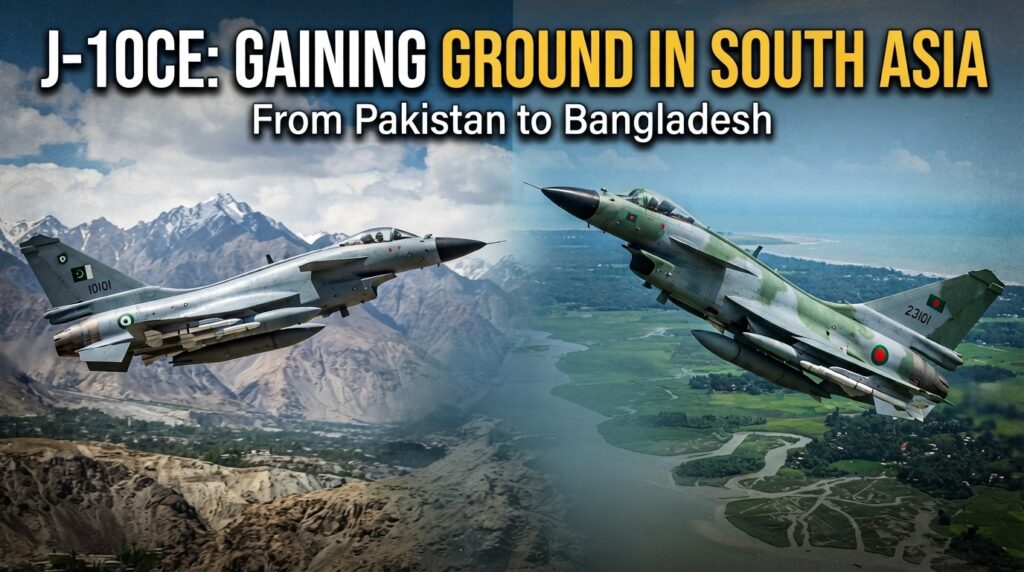
Bangladesh is moving closer to acquiring Chinese J-10CE fighter jets as Dhaka seeks to modernise its ageing combat-aircraft fleet and strengthen national air defence. The proposed purchase has drawn particular attention in Pakistan because the J-10C is already in Pakistan Air Force service and was used during the May 2025 India-Pakistan conflict. For China, meanwhile, a potential Bangladeshi order would represent another step in expanding the international footprint of its advanced fighter aircraft.
Bangladesh J-10CE Fighter Jets: What Is Dhaka Planning?
Bangladesh’s interest in the J-10CE is part of a broader effort to upgrade its air force. On August 25, Bangladesh’s Prime Minister’s Information and Broadcasting Adviser Zahed Ur Rahman said a draft agreement covering J-10CE multirole combat aircraft and attack helicopters had been prepared and sent to relevant authorities for approval. He did not initially disclose the final number of aircraft, price or delivery schedule.
Subsequent Bangladeshi reporting has put the proposed fighter purchase at 20 J-10CE aircraft for about $2.302 billion. The reported package includes training, logistics, infrastructure and other associated costs, meaning the headline figure should not be treated as the aircraft-only price.
That distinction is important. As of August 31, the available reporting indicates that Bangladesh is moving toward a purchase rather than announcing that all contractual and approval steps have been completed.
The acquisition would be significant for Bangladesh, whose fighter fleet has historically relied heavily on Chinese-origin aircraft. Earlier reporting said the Bangladesh Air Force operated 44 fighter aircraft, including 36 Chinese-made F-7s, underlining the pressure to replace older platforms with more capable systems.
Why the J-10CE Fighter Jet Pakistan Operates Matters
Pakistan is central to the story because it is the J-10CE’s established export user in the region. Pakistan inducted the J-10C, the domestic Chinese designation of the aircraft from which the export J-10CE is derived, as part of efforts to strengthen its fighter fleet. The aircraft’s profile rose sharply after the May 2025 India-Pakistan conflict.
Reuters reported in May 2025 that U.S. officials assessed with high confidence that Pakistani J-10s had been used to launch air-to-air missiles against Indian aircraft, with at least two Indian aircraft assessed as having been brought down. One U.S. official said at least one was a French-made Rafale. India did not acknowledge the specific losses at the time.
Pakistan subsequently claimed that its J-10s had shot down more Indian aircraft, including Rafales. India has disputed Pakistan’s broader claims, while later also acknowledging aircraft losses during the conflict. The competing accounts mean that individual combat claims should be treated cautiously.
Nevertheless, the episode changed the international discussion around Chinese fighter technology. Reuters later reported that the J-10C’s combat use had attracted attention from potential arms buyers and that Pakistan’s Chinese-built fighters had become part of a broader export conversation.
For Bangladesh, Pakistan’s experience provides something that brochures cannot: a nearby operator using the same basic aircraft family in a demanding regional security environment.
What Makes the J-10CE Attractive?
The J-10CE is a modern multirole fighter designed for air-to-air and air-to-ground missions. The J-10C family incorporates an active electronically scanned array (AESA) radar, upgraded avionics and electronic-warfare systems.
Its importance, however, is not simply about the aircraft’s specifications. Modern air combat increasingly depends on the combination of radar, electronic warfare, data links, airborne early-warning aircraft, pilot training and long-range missiles.
The J-10C has also been associated with China’s PL-15 family of beyond-visual-range air-to-air missiles. The export configuration and actual performance of weapons supplied to individual customers can differ, so published maximum-range figures should not automatically be interpreted as guaranteed combat ranges. For Bangladesh, the broader package could therefore matter as much as the fighter itself. Dhaka is also examining attack helicopters, VIP helicopters and unmanned aerial systems as part of its wider military modernisation effort.
Bangladesh China Fighter Jet Deal Could Deepen Defence Ties
China is already Bangladesh’s largest arms supplier, according to Reuters, with Beijing providing Dhaka with naval vessels, tanks, missile systems and combat aircraft over the past two decades. A J-10CE purchase would therefore build on an existing defence relationship rather than create an entirely new one.
For Beijing, Bangladesh would also offer another opportunity to demonstrate the export appeal of Chinese combat aviation.
The potential order comes at a time when China is seeking to expand the international market for its military technology. Reuters reported in February that the J-10C had gained greater visibility after Pakistan’s use of the aircraft in 2025, although Chinese fighter aircraft remained far from achieving mass-market adoption globally.
Chinese J-10CE in South Asia: A Growing Export Story
The J-10CE’s potential move from Pakistan to Bangladesh illustrates how combat experience can influence the international reputation of a weapon system.
Pakistan’s operational use of the J-10C has given the aircraft visibility that China could not have achieved through air shows and marketing alone. Bangladesh’s interest now suggests that the platform is being assessed not merely as a Chinese export product but as a fighter with demonstrated regional operational relevance.
Still, a successful purchase would depend on more than the aircraft’s reputation. Training, weapons supply, maintenance, spare parts, infrastructure and financing will all shape the J-10CE’s effectiveness in Bangladesh.
Why is Bangladesh interested in the J-10CE?
The aircraft offers Bangladesh a modern multirole capability as it seeks to replace or supplement older fighters. Pakistan’s operational experience with the platform has also increased attention around the aircraft.
Did Pakistani J-10CEs shoot down Indian Rafales?
Reuters reported in May 2025 that U.S. officials assessed with high confidence that Pakistani J-10s had brought down at least two Indian aircraft, including at least one Rafael, according to one U.S. official. Pakistan made broader claims, while India disputed aspects of Pakistan’s account. The precise number and circumstances of individual losses remain politically contested.
Bangladesh’s move toward the J-10CE is more than a single fighter purchase. It reflects Dhaka’s effort to modernise its air force, China’s expanding defence-export ambitions and the growing importance of Chinese military technology in South Asia.
For Pakistan, the development is particularly notable because the J-10C has already become part of the Pakistan Air Force’s modern combat fleet. If Bangladesh completes the proposed acquisition, the aircraft would have a second important South Asian operator, potentially strengthening the J-10 family’s position in the region’s increasingly competitive fighter market.
The final significance, however, will depend on whether the draft agreement becomes a signed contract and how Bangladesh integrates the aircraft, weapons, training and support infrastructure into its wider air-defence network.